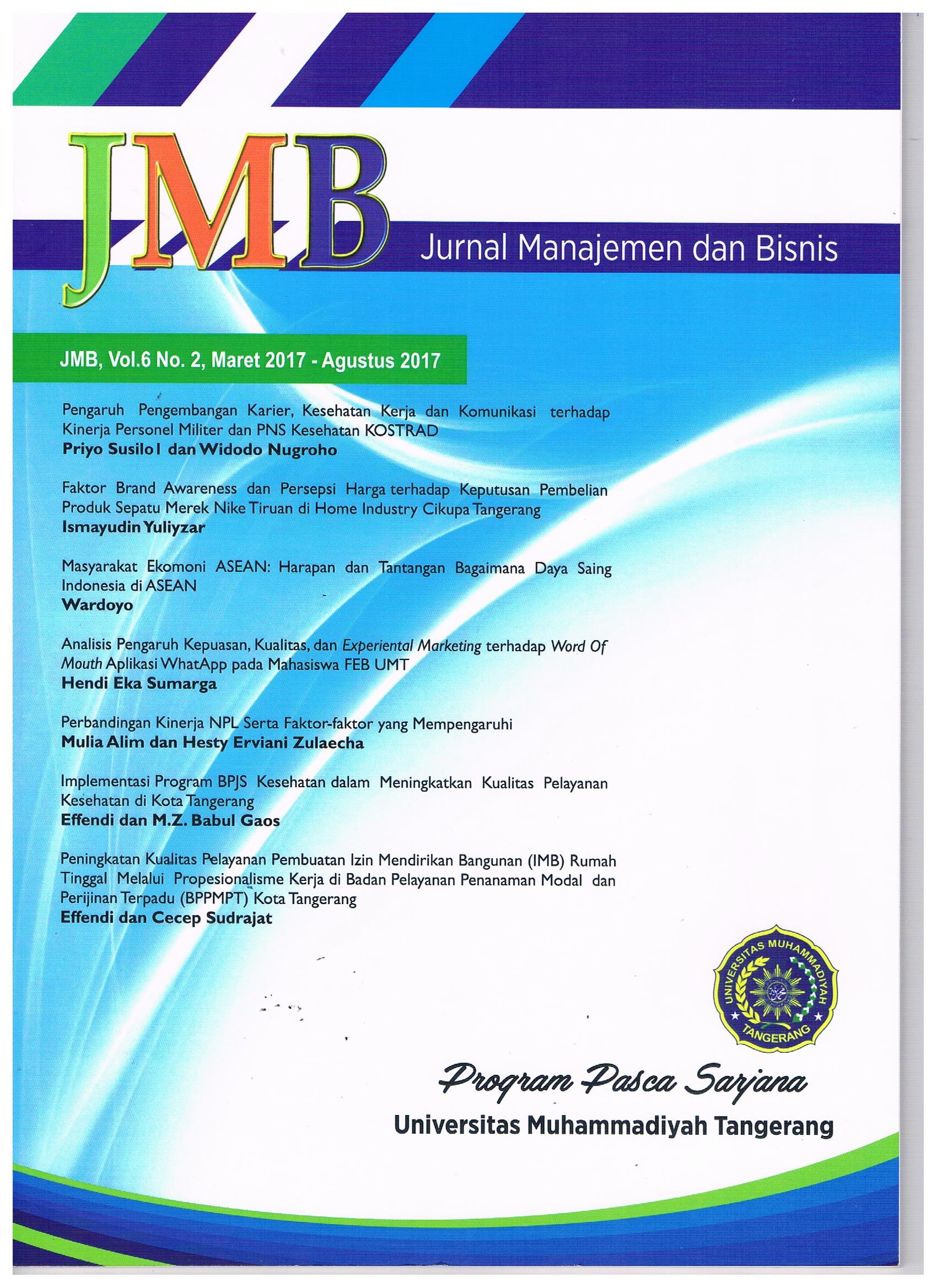
ANALISIS PENGARUH KEPUASAN, KUALITAS, DAN EXPERIENTIAL MARKETING TERHADAP WORD OF MOUTH APLIKASI WHATSAPP PADA MAHASISWA FEB UMT
DOI:
https://doi.org/10.31000/jmb.v6i2.1560Abstrak
This study aims to analyze the effects of satisfaction, quality, andexperiential marketing on the creation of word of mouth in the
application WhatsApp. This study uses three independent variables of
satisfaction, quality, and experiential marketing with one dependent
variable ie word of mouth. The use of variables in this study is expected
to know how the process occurs and what are the factors driving the
creation of word of mouth in WhatsApp application. The sample of this
research is user of WhatsApp application from student of Faculty of
Economics and Business of University of Muhammadiyah Tangerang.
Samples were taken with non probability sampling technique. Data
analysis of 160 respondents was done using Structural Equation
Modeling (SEM) as an analysis tool using LISREL 8.8 software. Based on
the results of data analysis, shows that: experiential marketing variables
have a positive influence and the greatest influence on word of mouth
WhatsApp applications, satisfaction variable has a positive influence on
word of mouth WhatsApp applications. The quality variable has the
least positive effect on word of mouth WhatsApp applications.
Referensi
Ahad, Annie Dayani and Lim, Syamimi Md Ariff
Convenience or Nuisance?:
The ‘Whatsapp’ Dilemma. Procedia
– Social and Behavioral Sciences 155 (p.
-196).
Al Hamdani, Dawood Salim 2013. Mobile
Learning: A Good Practice.Procedia
– Social and Behavioral Sciences 103 (p.
-674)
Andreani, Fransisca. 2007. Experiential
Marketing (Sebuah Pendekatan
Pemasaran).Jurnal Manajemen
Pemasaran, Volume 2 No 1. Universitas
Kristen Petra Surabaya.
Brown, et al., 2005. Spreading The Words:
Investigating Antecedents of
Customer’s Positive Word of
Mouth Intention And Behavior in
Retailing Context,Academy of
Marketing Science Journals, Vol.33, no
, p.123-138.
Engel, James et al. 2006. Consumer
Behaviour. Mason: Permissions
Department, Thomson Business and
Economics.
Fahima, Lim. 2007. Word of Mouth
Kalahkan Pengaruh Iklan ATL.
diakses pada tanggal 20 Maret 2018 dari
www.virtual.co.id
Feigenbaum, Vallin, Armand. 1992. Kendali
Mutu Terpadu. Jakarta: Erlangga.
Ferdinand, Augusty. 2006. Metode Penelitian
Manajemen. Edisi 2. Semarang: Badan
Penerbit Universitas Diponegoro.
Garvin, David A. (1988). Managing Quality,
The New York Press
Gwinner KP, Gremler DD, and Bitner MJ, 1998.
Relational Benefit in Service
Industries: The Customer
Perspective. Journal Academic
Marketing Science, Vol. 26, pp. 101-114.
Harrison, L. Jean-Walker. 2001. The
Measurement Of Word Of Mouth
Communication And An
Investigation Of Service Quality
And Customer Commitment As
Potential Antecedents. Journal of
Service Research,Vol. 4, No. 1, pp. 60-
Herr, P.M., Kardes, F.R. and Kim, J. 1991
Effects of word-of- mouth and
product attribute information on
persuasion: an accessibilitydiagnosticity
perspective. Journal of
Consumer Research 17, 454– 62.
Kartajaya, Hermawan. 2002. Hermawan
Kartajaya On Marketing. Jakarta: PT.
Gramedia Pustaka Utama.
Kotler, Philip. 2001. Manajemen Pemasaran:
Analisis, Perencanaan,
Implementasi, dan Kontrol. Jakarta :
PT. Prehallindo.
Nuys, David Van. 2005. The Viral Impact of
Experiental Marketing. Event
Marketer Magazine E-Focus Group.
Parasuraman, A. A. Zeithaml, V., and L. Berry, L.
A Conceptual Model of
Service Quality and Its
Implications for Future Research.
Journal of Marketing. Vol. 49 (fall)
Peter, J. Paul dan Jerry C Olson. 2002.
Perilaku Konsumen dan Strategi
Pemasaran. Terjemahan. Jakarta:
Erlangga.
Priharmoko, Patria. 2004. Faktor-faktor yang
mempengaruhi Word of Mouth
pada konsumen Studi kasus
pelanggan kartu halo DKI Jakarta.
Tesis. Universitas Indonesia. Depok.
Rangkuti, Freddy. 2002. Measuring Customer
Satisfaction Teknik Mengukur dan
Strategi Meningkatkan Kepuasan
Pelanggan dan Analisis Kasus PLNJP.
PT. Gramedia Pustaka Utama,
Jakarta.
Schmitt, Bernd H, 1999. Experiential
Marketing: how to get your
customers to sense, feel, think,
act, and relate to your company
and brand. The Free Press.
Sugiyono. 2013. Metode Penelitian
Kuantitatif Kualitatif dan R & D.
Bandung: Alfabeta.
Supomo, Bambang dan Indriantoro, Nur. 2002.
Metodologi Penelitian Bisnis,
Cetakan Kedua. Yogyakarta: Penerbit
BFEE UGM.
Thomas, Greg Metz. 2004. Bulding The Buzz
In The Hive Mind. Journal of
Consumer Behavior: Oct 2004; 4, 1:
ABI/INFORM Global.
Tjiptono, Fandy. 2006. Manajemen Jasa. Edisi
Pertama. Yogyakarta : Andi.
Wagner, J. and G. Rydstrom. 2001.
Satisfaction, trust, and
commitment in consumer
relationship with online retailer.
European Advances in Consumer
Research. 5. 276-281.
Wijanto, Setyo Hari. 2008. Structural
Equation Modeling dengan LISREL
8. Yogyakarta: Graha Ilmu.
Zeithaml. 1990. Delivering Quality Service.
New York: Mc Graw Hil.
Unduhan
Diterbitkan
Terbitan
Bagian
Lisensi
The Authors submitting a manuscript do so on the understanding that if accepted for publication, the copyright of the article shall be assigned to Indonesian Journal of Law and Policy Studies, Post Graduate in Law Universitas Muhammadiyah Tangerang, Indonesia as the publisher of the journal.
Jurnal Manajemen & Bisnis (JMB) right of first publication with the work simultaneously licensed under  Creative Commons Attribution-ShareAlike 4.0 International License (CC BY-SA 4.0) that allows others to share (copy and redistribute the material in any medium or format) and adapt (remix, transform, and build upon the material) the work for any purpose, even commercially with an acknowledgment of the work's authorship and initial publication in Jurnal Manajemen & Bisnis (JMB). Authors are able to enter into separate, additional contractual arrangements for the non-exclusive distribution of the journal's published version of the work (e.g., post it to an institutional repository or publish it in a book), with an acknowledgment of its initial publication in Jurnal Manajemen & Bisnis (JMB). Authors are permitted and encouraged to post their work online (e.g., in institutional repositories or on their website) prior to and during the submission process, as it can lead to productive exchanges, as well as earlier and greater citation of published work (See The Effect of Open Access).