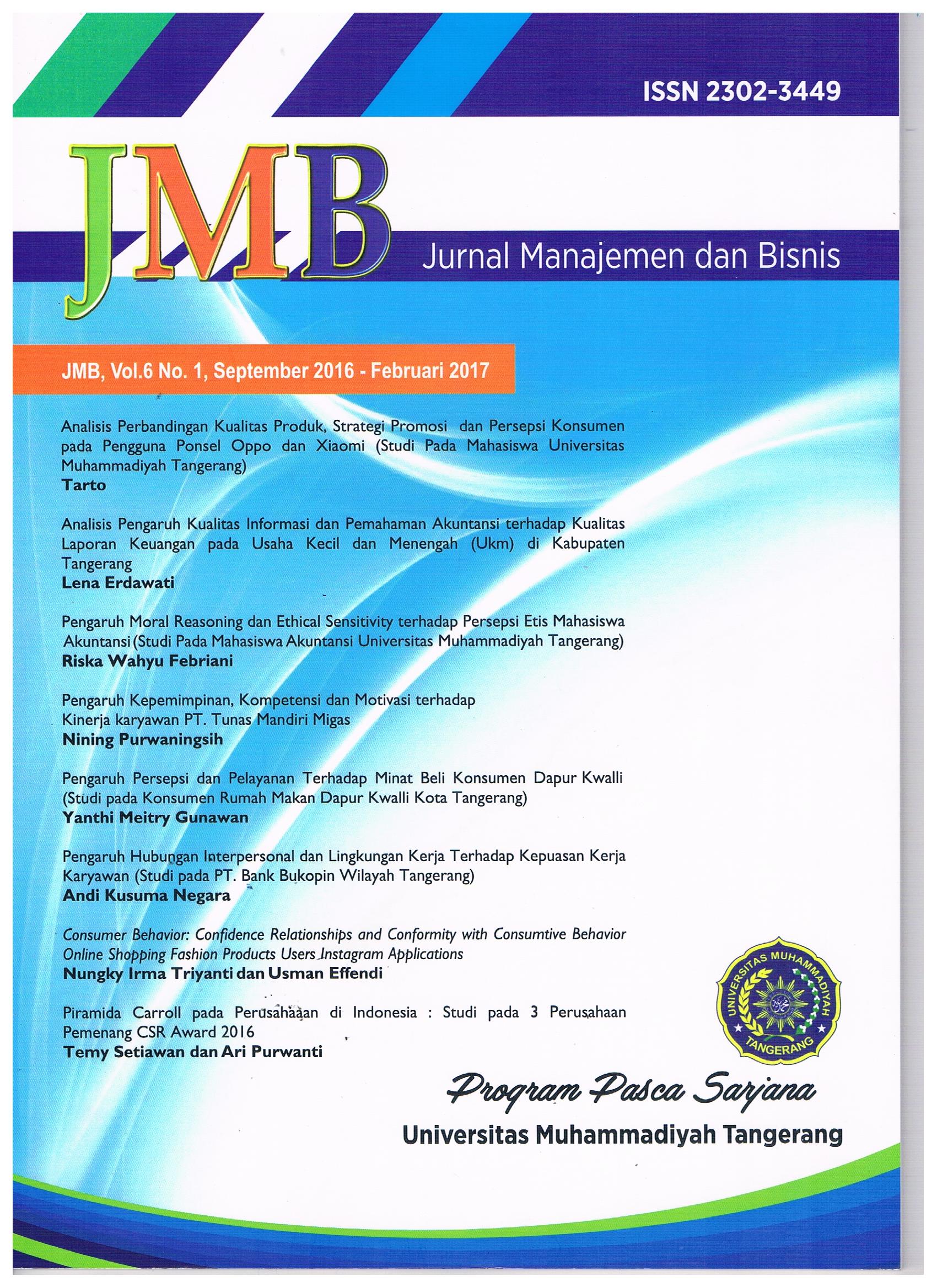
PENGARUH PERSEPSI DAN PELAYANAN TERHADAP MINAT BELI KONSUMEN DAPUR KWALLI (Studi Pada Konsumen Rumah Makan Dapur Kwalli Kota Tangerang)
DOI:
https://doi.org/10.31000/jmb.v6i1.993Abstrak
This study aims to determine whether perceptions and services have a positive and significant effect on consumer buying interest of Dapur Kwalli either partially or simultaneously. The research method used descriptive analysis method and multiple regression analysis method. This research uses primary data and secondary data. Researchers used 100 respondents as a sample. The results showed that perceptions and services have a positive and significant effect on consumer buying interest of Dapur Kwalli partially and simultaneously.
Penelitian ini bertujuan untuk mengetahui apakah persepsi dan layanan berpengaruh positif dan signifikan terhadap minat beli konsumen Dapur Kwalli baik secara parsial maupun simultan. Metode penelitian menggunakan metode analisis deskriptif dan metode analisis menggunakan regresi berganda. Penelitian ini menggunakan data primer dan data sekunder. Peneliti menggunakan 100 responden sebagai sampel. Hasil penelitian menunjukkan bahwa persepsi dan layanan memiliki pengaruh positif dan signifikan terhadap minat beli konsumen Dapur Kwalli secara parsial dan simultan.
Referensi
Durianto, Darmadi, dkk. 2003, Invasi Pasar dengan Iklan yang Efektif. Jakarta: Gramedia.
Ferdinand, Augusty. 2011, Metode Penelitian Manajemen Pedoman Penelitian untuk Penulisan Skripsi, Tesis, dan Disertasi Ilmu Manajemen, Edisi 3. AGF Books. Fakultas Ekonomika dan Bisnis Universitas Diponegoro. Semarang.
Ghozali, Imam. 2006, Aplikasi Analisis Multivariate dengan Program SPSS. Semarang: Badan Penerbit UNDIP.
Hasan, Iqbal. 2002, Pokok-pokok Materi Metode Penelitian dan Aplikasinya. Jakarta: Ghalia Indonesia.
Kotler, Bowen & James Makens. 2002, Pemasaran Perhotelan dan Kepariwisataan, Edisi kedua. Jakarta: Prenhallindo.
Marsum. 2001, Restoran dan Segala Permasalahannya. Yogyakarta: Penerbit Andi.
Moenir, A.S. 2010, Manajemen Pelayanan Umum Di Indonesia. Jakarta: Bumi Aksara.
Priyatno, Duwi. 2009, SPSS untuk Analisis Korelasi, Regresi, dan Multivariate. Yogyakarta: Gava Media.
Sekaran, Uma. 2014, Metodologi Penelitian untuk Bisnis (Research Methods for Business). Buku 1 Edisi 4. Salemba Empat. Jakarta.
Setiadi, Nugroho J. 2003, Perilaku Konsumen: Konsep dan Implikasi untuk Strategi dan Penelitian Pemasaran. Kencana. Jakarta.
Stanton, William J. 2012, Prinsip Pemasaran. Alih bahasa: Yohanes Lamarto. Penerbit Erlangga. Jakarta
Sugihartono, dkk. 2007, Psikologi Pendidikan. UNY Press. Yogyakarta.
Sugiyono. 2009, Metode Penelitian Bisnis. Alfabeta. Bandung.
Swastha, Basu. 2000, Pengantar Bisnis Modern, Pengantar Ekonomi Perusahaan Modern. Jakarta: Liberty.
Tjiptono, Fandy. 2005, Pemasaran Jasa. Malang: Bayumedia Publishing.
Widiyanto, Ibnu. 2008, Pointers Metodologi Penelitian. Semarang: CV Dikalia.
Unduhan
Diterbitkan
Terbitan
Bagian
Lisensi
The Authors submitting a manuscript do so on the understanding that if accepted for publication, the copyright of the article shall be assigned to Indonesian Journal of Law and Policy Studies, Post Graduate in Law Universitas Muhammadiyah Tangerang, Indonesia as the publisher of the journal.
Jurnal Manajemen & Bisnis (JMB) right of first publication with the work simultaneously licensed under  Creative Commons Attribution-ShareAlike 4.0 International License (CC BY-SA 4.0) that allows others to share (copy and redistribute the material in any medium or format) and adapt (remix, transform, and build upon the material) the work for any purpose, even commercially with an acknowledgment of the work's authorship and initial publication in Jurnal Manajemen & Bisnis (JMB). Authors are able to enter into separate, additional contractual arrangements for the non-exclusive distribution of the journal's published version of the work (e.g., post it to an institutional repository or publish it in a book), with an acknowledgment of its initial publication in Jurnal Manajemen & Bisnis (JMB). Authors are permitted and encouraged to post their work online (e.g., in institutional repositories or on their website) prior to and during the submission process, as it can lead to productive exchanges, as well as earlier and greater citation of published work (See The Effect of Open Access).