IDENTIFICATION OF STUDENT MISCONCEPTIONS BASED ON FIELD-DEPENDENT AND FIELD-INDEPENDENT COGNITIVE STYLES THROUGH THE JIGSAW LEARNING MODEL
DOI:
https://doi.org/10.31000/prima.v9i1.12710Abstract
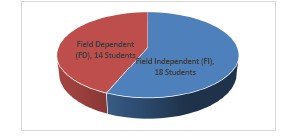
This study aims to identify students' misconceptions based on field-dependent (FD) and field-independent (FI) cognitive styles through the application of the Jigsaw learning model, particularly in mathematics learning. The research subjects consisted of 4 seventh-grade students at SMPN 1 Bolo, divided into FD and FI groups based on the results of the Group Embedded Figures Test (GEFT). The findings show that FD students had a higher misconception rate than FI students. A total of 35% of FD students experienced misconceptions. On the other hand, FI students had a lower percentage of misconceptions, at 15%. Applying the Jigsaw learning model successfully reduced misconceptions in both groups, especially among FI students, who are naturally more independent in processing information. However, FD students require additional intervention in the form of guidance and peer support to enhance their understanding. In conclusion, the Jigsaw learning model is effective in reducing misconceptions, particularly for FI students, but it still requires adaptations for FD students to achieve optimal results.
Downloads
Published
Issue
Section
License
Authors who publish with Prima: Jurnal Pendidikan Matematika agree to the following terms: Authors retain copyright and grant the Prima: Jurnal Pendidikan Matematika right of first publication with the work simultaneously licensed under a Creative Commons Attribution License (CC BY-SA 4.0) that allows others to share (copy and redistribute the material in any medium or format) and adapt (remix, transform, and build upon the material) the work for any purpose, even commercially with an acknowledgement of the work's authorship and initial publication in Prima: Jurnal Pendidikan Matematika. Authors are able to enter into separate, additional contractual arrangements for the non-exclusive distribution of the journal's published version of the work (e.g., post it to an institutional repository or publish it in a book), with an acknowledgement of its initial publication in Prima: Jurnal Pendidikan Matematika. Authors are permitted and encouraged to post their work online (e.g., in institutional repositories or on their website) prior to and during the submission process, as it can lead to productive exchanges, as well as earlier and greater citation of published work (See The Effect of Open Access).