OPTIMIZATION OF DIGITAL LITERACY THROUGH STEM-BASED LEARNING
DOI:
https://doi.org/10.31000/prima.v9i1.12851Keywords:
digital literacy, STEM, vector algebraAbstract
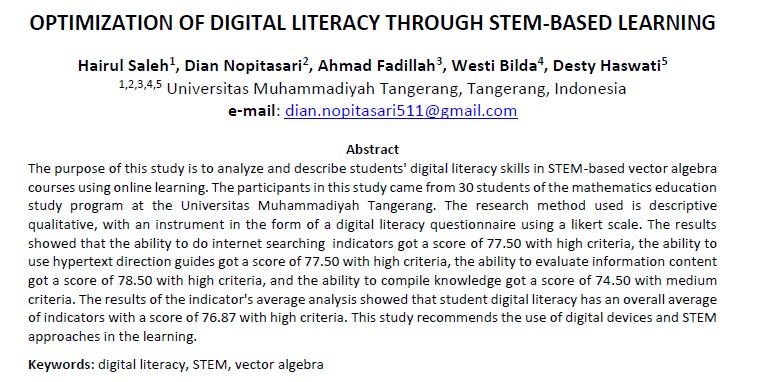
The purpose of this study is to analyze and describe students' digital literacy skills in STEM-based vector algebra courses using online learning. The participants in this study came from 30 students of the mathematics education study program at the Universitas Muhammadiyah Tangerang. The research method used is descriptive qualitative, with an instrument in the form of a digital literacy questionnaire using a likert scale. The results showed that the ability to do internet searching indicators got a score of 77.50 with high criteria, the ability to use hypertext direction guides got a score of 77.50 with high criteria, the ability to evaluate information content got a score of 78.50 with high criteria, and the ability to compile knowledge got a score of 74.50 with medium criteria. The results of the indicator's average analysis showed that student digital literacy has an overall average of indicators with a score of 76.87 with high criteria. This study recommends the use of digital devices and STEM approaches in the learning procesReferences
Agyei, E., Agyei, D. D., & Benning, I. (2024). Teaching Mathematics with Digital Technologies: A Situational Analysis of High School Teachers’ Experiences in Ghana. African Journal of Research in Mathematics, Science and Technology Education, 28(1). https://doi.org/10.1080/18117295.2023.2265241
Brunetto, D., & Iacono, U. Dello. (2024). Teaching Mathematics with Digital Tools: An Italian High School Teachers’ Perspective. International Journal for Technology in Mathematics Education, 30(4). https://doi.org/10.1564/tme_v30.4.1
Cheema, J. R. (2013). Does it matter how you measure it? the case of self-efficacy in mathematics. Issues in Educational Research, 23(3), 346–356. http://www.iier.org.au/iier23/cheema.html
Chittum, J. R., Jones, B. D., Akalin, S., & Schram, Ã. B. (2017). The effects of an afterschool STEM program on students’ motivation and engagement. International Journal of STEM Education, 4(1), 1–16. https://doi.org/10.1186/s40594-017-0065-4
Coleman, M. L., Ragan, M., & Dari, T. (2024). Intercoder Reliability for Use in Qualitative Research and Evaluation. Measurement and Evaluation in Counseling and Development, 57(2). https://doi.org/10.1080/07481756.2024.2303715
Crews, J., & Parker, J. (2017). The Cambodian experience: exploring university students’ perspectives for online learning. Issues in Educational Research, 27(4), 697–719.
Dridi, T. (2023). Tunisian High School Students and Digital Media Literacy: A Quantitative Study. Journal of Education, 203(1). https://doi.org/10.1177/00220574211025979
Erdem, C., Oruç, E., Atar, C., & Bağcı, H. (2023). The mediating effect of digital literacy in the relationship between media literacy and digital citizenship. Education and Information Technologies, 28(5). https://doi.org/10.1007/s10639-022-11354-4
Fadillah, A., Sukmawati, R., & Rahardjo, S. (2021). AKSIOMA: Jurnal Program Studi Pendidikan Matematika 1206| ANALYSIS OF STUDENT DIGITAL LITERACY IN LINEAR ALGEBRA COURSES DURING THE COVID-19 PANDEMIC. 10(2), 1206–1212. https://doi.org/10.24127/ajpm.v10i2.3704
Falloon, G., Hatzigianni, M., Bower, M., Forbes, A., & Stevenson, M. (2020). Understanding K-12 STEM Education: a Framework for Developing STEM Literacy. In Journal of Science Education and Technology (Vol. 29, Issue 3). https://doi.org/10.1007/s10956-020-09823-x
Feng, S., Garimella, U., & Pinchback, C. (2020). Integrating Literacy into STEM Education: Changing Teachers’ Dispositions and Classroom Practice. Journal of STEM Teacher Education, 54(1). https://doi.org/10.30707/jste55.1/zqjk5370
Gumiero, B. S., & Pazuch, V. (2024). Digital technologies and mathematics teaching: An analysis of teacher professional knowledge. Pedagogical Research, 9(2). https://doi.org/10.29333/pr/14342
Hague, C., & Payton, S. (2011). Curriculum & Leadership Journal | Digital literacy across the curriculum. Curriculum & Leadership Journal, 9(10), 1–10. http://www.curriculum.edu.au/leader/default.asp?id=33211&issueID=12380
Holden, M. (2020). Developing STEM literacy with young learners. IUL Research.
Huang, X., Erduran, S., Luo, K., Zhang, P., & Zheng, M. (2022). Investigating in-service teachers’ STEM literacy: the role of subject background and gender. Research in Science and Technological Education. https://doi.org/10.1080/02635143.2022.2153243
JiÅ™Ã, M., Cristina, P. R., Carlos, F., Jean-Pierre, M., & Tristan, M. (2021). The 5-Item Likert Scale and Percentage Scale Correspondence with Implications for the Use of Models with (Fuzzy) Linguistic Variables. Revista de Metodos Cuantitativos Para La Economia y La Empresa, 31, 3–16. https://doi.org/10.46661/REVMETODOSCUANTECONEMPRESA.4010
Jones, S. L., & Procter, R. (2023). Young peoples’ perceptions of digital, media and information literacies across Europe: gender differences, and the gaps between attitudes and abilities. Technology, Pedagogy and Education, 32(4). https://doi.org/10.1080/1475939X.2023.2210152
Kayaduman, H., Battal, A., & Polat, H. (2023). The relationship between undergraduate students’ digital literacy and self-regulation in online interaction. Innovations in Education and Teaching International, 60(6). https://doi.org/10.1080/14703297.2022.2113113
Marty, P. F., Alemanne, N. D., Mendenhall, A., Maurya, M., Southerland, S. A., Sampson, V., Douglas, I., Kazmer, M. M., Clark, A., & Schellinger, J. (2013). Scientific inquiry, digital literacy, and mobile computing in informal learning environments. Learning, Media and Technology, 38(4), 407–428. https://doi.org/10.1080/17439884.2013.783596
Nikou, S., De Reuver, M., & Mahboob Kanafi, M. (2022). Workplace literacy skills—how information and digital literacy affect adoption of digital technology. Journal of Documentation, 78(7), 371–391. https://doi.org/10.1108/JD-12-2021-0241
Pimthong, P., & Williams, J. (2020). Preservice teachers’ understanding of STEM education. Kasetsart Journal of Social Sciences, 41(2), 289–295. https://doi.org/10.1016/j.kjss.2018.07.017
Polizzi, G. (2020). Digital literacy and the national curriculum for England: Learning from how the experts engage with and evaluate online content. Computers and Education, 152(1), 1–13. https://doi.org/10.1016/j.compedu.2020.103859
Roefs, E. C. J., Oosterheert, I. E., Leeman, Y. A. M., van der Veld, W. M., & Meijer, P. C. (2024). Investigating ‘Presence in teaching’: explicating the transition from qualitative studies to a survey instrument. International Journal of Research and Method in Education, 47(3). https://doi.org/10.1080/1743727X.2023.2281318
Saetang, W., Seksan, J., & Thongsri, N. (2023). HOW ACADEMIC MAJORS IN NON-STEM AFFECT DIGITAL LITERACY: THE EMPIRICAL STUDY. Journal of Technology and Science Education, 13(3). https://doi.org/10.3926/JOTSE.1791
Setiyani, Waluya, S. B., Sukestiyarno, Y. L., & Cahyono, A. N. (2022). Mathematical Reflective Thinking Process of Prospective Elementary Teachers Review from the Disposition in Numerical Literacy Problems. In International Journal of Educational Methodology (Vol. 8, Issue 3). https://doi.org/10.12973/IJEM.8.3.405
Soyoof, A., Reynolds, B. L., Neumann, M., Scull, J., Tour, E., & McLay, K. (2024). The impact of parent mediation on young children’s home digital literacy practices and learning: A narrative review. In Journal of Computer Assisted Learning (Vol. 40, Issue 1). https://doi.org/10.1111/jcal.12866
Strimel, G., Bartholomew, S., & Kim, E. (2017). Engaging Children in Engineering Design Through the World of Quadcopters. Children’s Technology and Engineering Journal, 21(4), 7–11. https://scholarsarchive.byu.edu/facpub/5587 %0D
Vennix, J., den Brok, P., & Taconis, R. (2018). Do outreach activities in secondary STEM education motivate students and improve their attitudes towards STEM? International Journal of Science Education, 40(11), 1263–1283. https://doi.org/10.1080/09500693.2018.1473659
Wang, H. H., Hong, Z. R., She, H. C., Smith, T. J., Fielding, J., & Lin, H. shyang. (2022). The role of structured inquiry, open inquiry, and epistemological beliefs in developing secondary students’ scientific and mathematical literacies. International Journal of STEM Education, 9(1). https://doi.org/10.1186/s40594-022-00329-z
Weyant, E. (2022). Research Design: Qualitative, Quantitative, and Mixed Methods Approaches, 5th Edition. Journal of Electronic Resources in Medical Libraries, 19(1–2), 54–55. https://doi.org/10.1080/15424065.2022.2046231
Wu, Z., Huang, L., Liu, Y. K., & Chiang, F. K. (2024). Developing a Framework of STEM Literacy for Kindergarten Children. Research in Science Education. https://doi.org/10.1007/s11165-024-10157-6
Yan, D., Adi Kasuma, S. A., & Amini, M. (2023). Gender Difference in Digital Literacy Among Translation Trainees: Self-perceptions and Application Abilities. International Journal of Academic Research in Progressive Education and Development, 12(3). https://doi.org/10.6007/ijarped/v12-i3/19611
Downloads
Published
Issue
Section
License
Authors who publish with Prima: Jurnal Pendidikan Matematika agree to the following terms: Authors retain copyright and grant the Prima: Jurnal Pendidikan Matematika right of first publication with the work simultaneously licensed under a Creative Commons Attribution License (CC BY-SA 4.0) that allows others to share (copy and redistribute the material in any medium or format) and adapt (remix, transform, and build upon the material) the work for any purpose, even commercially with an acknowledgement of the work's authorship and initial publication in Prima: Jurnal Pendidikan Matematika. Authors are able to enter into separate, additional contractual arrangements for the non-exclusive distribution of the journal's published version of the work (e.g., post it to an institutional repository or publish it in a book), with an acknowledgement of its initial publication in Prima: Jurnal Pendidikan Matematika. Authors are permitted and encouraged to post their work online (e.g., in institutional repositories or on their website) prior to and during the submission process, as it can lead to productive exchanges, as well as earlier and greater citation of published work (See The Effect of Open Access).