THE EFFECT OF DIFFERENTIATED LEARNING ON STUDENTS’ COMPUTATIONAL THINKING SKILS IN MATHEMATICS LEASSONS
DOI:
https://doi.org/10.31000/prima.v9i1.13100Keywords:
computational thinking ability, differentiated learning, lecture learningAbstract
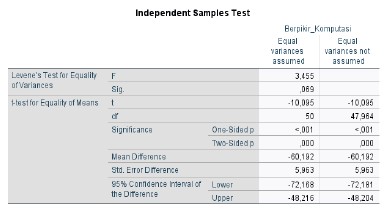
This study aims to analyze the effect of differentiated learning on students' computational thinking skills in mathematics. This research was conducted at MAN Sibolga, located in Sibolga in the odd semester of the 2024/2025 school year. The method used was a quasi-experiment with a pretest-posttest non-equivalent control group design. The sampling technique was carried out using purposive sampling technique, where class XI-A was the experimental class with 26 students, while class XI-F was the control class with 26 students. Data collection regarding students' computational thinking skills used a test instrument consisting of five description items that had gone through the validity and reliability testing process. The indicators of computational thinking ability studied included problem decomposition, abstraction, algorithm thinking, generalization, and debugging. The results showed that students taught using differentiated learning model had higher computational thinking ability compared to students taught through lecture learning model.
Downloads
Published
Issue
Section
License
Authors who publish with Prima: Jurnal Pendidikan Matematika agree to the following terms: Authors retain copyright and grant the Prima: Jurnal Pendidikan Matematika right of first publication with the work simultaneously licensed under a Creative Commons Attribution License (CC BY-SA 4.0) that allows others to share (copy and redistribute the material in any medium or format) and adapt (remix, transform, and build upon the material) the work for any purpose, even commercially with an acknowledgement of the work's authorship and initial publication in Prima: Jurnal Pendidikan Matematika. Authors are able to enter into separate, additional contractual arrangements for the non-exclusive distribution of the journal's published version of the work (e.g., post it to an institutional repository or publish it in a book), with an acknowledgement of its initial publication in Prima: Jurnal Pendidikan Matematika. Authors are permitted and encouraged to post their work online (e.g., in institutional repositories or on their website) prior to and during the submission process, as it can lead to productive exchanges, as well as earlier and greater citation of published work (See The Effect of Open Access).