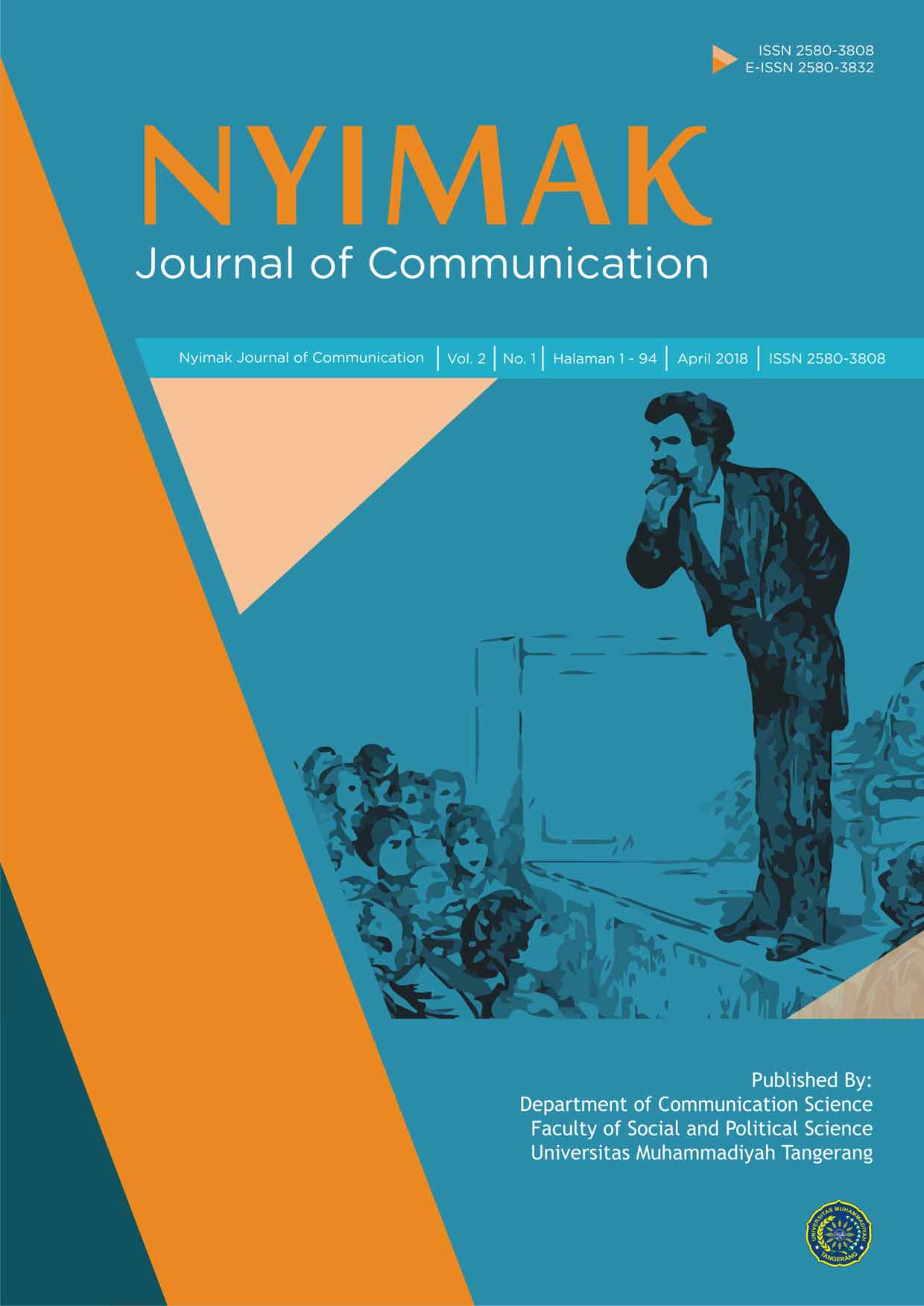
SELF DISCLOSURE MELALUI MEDIA SOSIAL INSTAGRAM (Studi Kasus Pada Anggota Galeri Quote)
DOI:
https://doi.org/10.31000/nyimak.v2i1.687Abstract
Penelitian ini bertujuan untuk mengetahui konsep Johari Window anggota Galeri Quote dalam melakukan kegiatan self disclosure melalui media sosial Instagram. Penelitian ini adalah penelitian kualitatif dengan pendekatan studi kasus. Teknik analisis data dilakukan melalui observasi pada akun Instagram Galeri Quote, yaitu dengan cara menganalisis postingan teks berupa komentar-komentar yang diberikan pengguna Instagram. Analisis data dilakukan dengan menggunakan model Miles & Huberman karena berkaitan dengan masalah penelitian, yaitu self disclosure pada anggota Galeri Quote. Hasil penelitian menunjukkan bahwa anggota Galeri Quote memanfaatkan media sosial Instagram untuk memenuhi kebutuhan aktualisasi diri mereka, dan di balik quotes tersebut terdapat maksud lain yang berhubungan dengan konsep Johari Windows. Meskipun quotes yang dibuat dalam bentuk quotes dakwah atau inspirasi, hal tersebut juga sekaligus menjadi ajang dalam mencurahkan perasaan, pikiran, dan pengalaman hidup.
Kata Kunci: Self disclosure, Johari Window, media sosial, Instagram
This study aims to determine the concept of Johari Window toward Gallery Quote’s Member in conducting self disclosure activities through social media Instagram. This research is a qualitative research with case study approach. Technique of data analysis is done through observation on Instagram Gallery Quote’s account by analyzing text post in the form of comments given by Instagram’s users. Data analysis was done by using Miles & Huberman model since it related to research problem: self disclosure on Gallery Quote’s member. The results of this study show that members of Gallery Quote utilize social media Instagram to meet their self actualization needs, and behind the quotes there is another meaning associated with the Johari Windows concept. Although the quotes are made in the form of ‘da’wah or inspiration quotes, they also serve as a venue for devoting feelings, thoughts, and life experiences.
Keywords: Self disclosure, Johari Window, Social Media, Instagram
References
Al-Kandari, Ali, Srinivas R. Melkote and Ahmad Sharif. (2016). “Needs and Motives Of Instagram Users that Predict Self-Disclosure Use: A Case Study of Young Adults in Kuwaitâ€. Journal of Creative Communications, 11(2): 85-101.
Arifiani, Septina. (1 Agustus 2014). Duh, Curhat di Media Sosial Justru Bisa Bikin Anda Merasa Lebih Buruk. Diakses dari: http://www.jatengpos.com/2014/08/hasil-penelitian-duh-
curhat-di-media-sosial-justru-bisa-bikin-anda-merasa-lebih-buruk-523202
Arnus, Sri Hadijah. (2016). “Self Disclosure di Media Sosial pada Mahasiswa IAIN Kendari (Suatu Kajian Psikologi Komunikasi Pada Pengguna Media Sosial)â€. Al-Izzah, 11(2): 1-18.
Atmoko, Dwi Bambang. 2012. Instagram Handbook: Tips Fotografi Ponsel. Jakarta: Media Kita.
Ayub, Kanda, Novaria Maulina dan Muhammad Alif. (2017). “Self Disclosure Chef Agus Sasirangan di Media Sosial Instagramâ€. Meta Communication: Journal of Communication Studies, 1(2): 1-13.
Ayudhya, Fentira. (2017). “Instagram dan Presentasi Diri Mahasiswa (Studi Korelasional Penggunaan Instagram Terhadap Presentasi Diri Mahasiswa Fakultas Ilmu Sosial dan Ilmu Politik Departemen Ilmu Komunikasi Universitas Sumatera Utara)â€. Flow, 3(5): 1-10.
Ayun, Primada Qurrota. (2015). “Fenomena Remaja Menggunakan Media Sosial dalam Membentuk Identitasâ€. Channel (Jurnal Komunikasi), 3(2): 1-6.
Bazarova, Natalya N. and Yoon Hyung Choi. (2014). “Self-Disclosure in Social Media: Extending the Functional Approach to Disclosure Motivations and Characteristics on Social Network Sitesâ€. Journal of Communication, 64(4): 635-657.
Cangara, Hafied. (2016). Pengantar Ilmu Komunikasi. Jakarta: Rajawali Pers. Devito, Joseph. (2011). Komunikasi Antar Manusia. Tangerang Selatan: Karisma Publishing Group.
Dominick, Joseph R. (1999). “Who Do You Think You Are? Personal Home Pages and Self- Presentation on the World Wide Webâ€. Journalism & Mass Communication Quarterly, 76(4): 646–658.
Feng, Jinjuan, Jonathan Lazar and Jenny Preece. (2007). “Empathy and Online Interpersonal Trust: A Fragile Relationshipâ€. Behaviour & Information Technology, 23(2): 97-106.
Jongtae Yu, Paul Jen-Hwa & Tsang-Hsiang Cheng. (2015). “Role of Affect in Self-Disclosure on Social Network Websites: A Test of Two Competing Modelsâ€. Journal of Management Information Systems, 32(2): 239-277.
Kaplan, Andreas and Michael Haenlein. (2010). “Users of the World, Unite! The Chalanges and Opportunities of Social Mediaâ€, Business Horizons, 53(1): 59-68.
Kusyanti, Ari dan One Safitri. (2016). “How Do I Look: Self-Disclosure of Instagram Users in Indonesiaâ€. Journal of Education and Social Sciences, 5(2): 242-247.
Lin, Han, William Tov and Lin Qiu. (2014). “Emotional Disclosure on Social Networking Sites: The Role of Network Structure and Psychological Needsâ€. Computers in Human Behavior, 41, 342-350.
Mahendra, Bimo. (2017). “Eksistensi Sosial Remaja dalam Instagram (Sebuah Perspektif Komunikasi)â€. Jurnal Visi Komunikasi, 16(1): 151-160.
Mailanto, Arsan. (14 Januari 2016). Pengguna Instagram di Indonesia Terbanyak, Mencapai 89%. Diakses dari: https://techno.okezone.com/read/2016/01/14/207/1288332/pengguna-
instagram-di-indonesia-terbanyak-mencapai-89
Nasrullah, Rulli. (2017). Media Sosial: Perspektif Komunikasi, Budaya, dan Sosioteknologi. Bandung: Simbiosa Rekatama Media.
Newstrom, John W. and Stephen A. Rubenfeld. (1983). “The Johari Window: A Reconceptualizationâ€. Developments in Business Simulation & Experiential Exercises, 10, 117-120.
Pohan, Fionna Almira & Hairul Anwar Dalimunthe. (2017). “Hubungan Inmate Friendship dengan Self-Disclosure pada Mahasiswa Psikologi Pengguna Media Sosialâ€. Jurnal Diversita, 3(2): 15-24.
Ridings, Catherine M., David Gefen and Bay Arinze. (2002). “Some Antecedents and Effects of Trust in Virtual Communitiesâ€. Journal of Strategic Information Systems, 11(3-4): 271-295.
Salamoon, Daniel Kurniawan. (2013). Instagram, Ketika Foto Menjadi Mediator Komunikasi Lintas Budaya Di Dunia Maya. Makalah Konferensi. Diakses dari: http://repository.petra.ac.id/16642/
Schau, Hope Jensen and Mary C. Gilly. (2003). “We Are What We Post? Self Presentation in Personal Web Spaceâ€. Journal of Consumer Research, 30(3): 385-404.
Sears, David O. (2001). Psikologi Sosial. Jakarta: Erlangga. Spiekermann, Sarah [et al.]. (2012). “Online Social Networks: Why We Discloseâ€. Journal of Information Technology, 25(2): 109-125.
Stutzman, F. (2006) “An Evaluation of Identity-Sharing Behavior in Social Network Communitiesâ€. International Digital and Media Arts Journal, 3(1): 10-18.
Williamson, Patricia [et al.]. (2017). “Me, My ‘Selfie’ and I: A Survey of Self-disclosure Motivations on Social Mediaâ€. IAFOR Journal of Cultural Studies, 2(2): 71-85.
Downloads
Published
Issue
Section
License
The Authors submitting a manuscript do so on the understanding that if accepted for publication, copyright of the article shall be assigned to Nyimak: Journal of Communication. Communication Science Study Program, Faculty of Social and Political Sciences, Universitas Muhammadiyah Tangerang, Indonesia as the publisher of the journal. Nyimak: Journal of Communication right of first publication with the work simultaneously licensed under Creative Commons Attribution-ShareAlike 4.0 International License (CC BY-SA 4.0) that allows others to share (copy and redistribute the material in any medium or format) and adapt (remix, transform, and build upon the material) the work for any purpose, even commercially with an acknowledgment of the work's authorship and initial publication in Nyimak: Journal of Communication. Authors are permitted and encouraged to post their work online (e.g., in institutional repositories or on their website) prior to and during the submission process, as it can lead to productive exchanges, as well as earlier and greater citation of published work (See The Effect of Open Access).