Fiscal Decentralization and Poverty Paradox in Papua: Governance Failures under Special Autonomy
DOI:
https://doi.org/10.31000/jgcs.v10i1.15185Keywords:
Special Autonomy Fund, Poverty, Local Economic Growth, PapuaAbstract
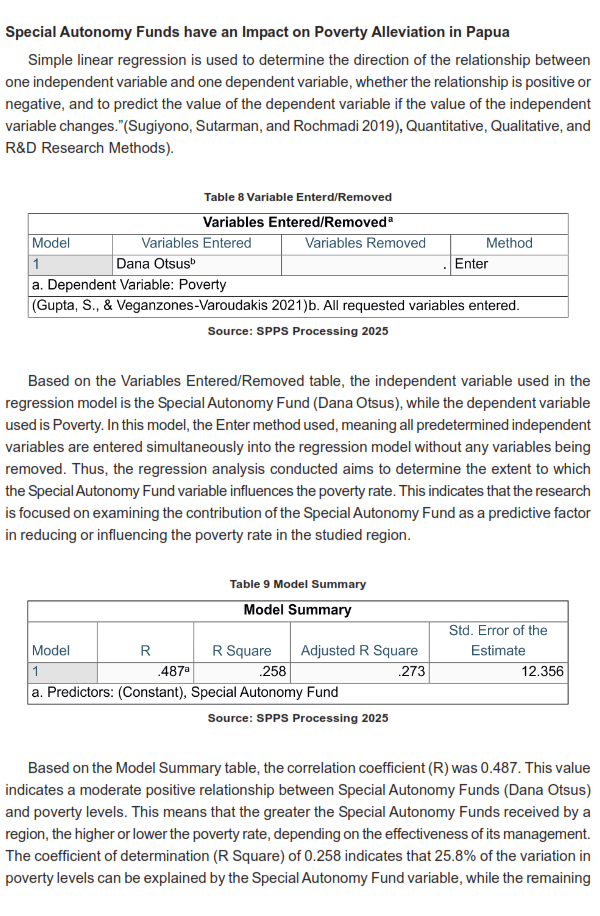
This study aims to analyze the influence of the Special Autonomy Fund (Otsus) and local economic growth on poverty levels in Papua. The study uses a Mix method approach, namely quantitative data with survey methods, Questionnaires and reports on the realization of the Special Autonomy Fund and qualitative data namely interviews. Data analysis techniques include correlation tests and multiple linear regression. The results of the study indicate that Regional Economic Growth is Significantly Correlated with Poverty Alleviation The results of the Pearson correlation test (r = 0.765; p < 0.05) indicate that regional economic growth has a strong and significant relationship with poverty alleviation, the Special Autonomy Fund (Otsus) Has a Significant Impact But Is Not Yet Effective in Poverty Alleviation The results of simple regression show a positive coefficient (B = 0.532), the R Square value is only 25.8%, so the Special Autonomy Fund is only able to explain a quarter of the variation in poverty, while 74.2% is influenced by other factors (human resources, governance, infrastructure, income distribution). The Special Autonomy Fund and local economic growth simultaneously significantly influence poverty reduction, with an R value of 0.856 and an R Square of 0.873, meaning 87.3% of the poverty variable can be explained by these two variables. The Durbin-Watson value of 2.112 indicates no autocorrelation in the model. Partially, the Special Autonomy Fund has a positive and significant effect on improving access to public services and community income, while local economic growth also strengthens poverty reduction.
Meskipun lebih dari dua dekade implementasi Otonomi Khusus (Otsus) dan pencairan lebih dari Rp 138,65 triliun, tingkat kemiskinan Papua tetap berada di angka 26,03–34,26% jauh di atas rata-rata nasional menampakkan paradoks mendasar antara desentralisasi fiskal skala besar dan hasil pembangunan inklusif. Studi yang ada telah menilai efektivitas Otsus terutama pada tingkat makro-fiskal, mengabaikan kualitas tata kelola sebagai variabel mediasi yang penting. Studi ini mengatasi kesenjangan tersebut dengan meneliti bagaimana dana Otsus dan pertumbuhan ekonomi lokal secara bersamaan memengaruhi kemiskinan di Papua, menggunakan desain penjelasan sekuensial metode campuran yang menggabungkan regresi linier berganda (n=240) dengan wawancara kualitatif sistematis terhadap informan kunci. Temuan menunjukkan paradoks struktural, peningkatan alokasi Otsus berkorelasi dengan kemiskinan yang lebih tinggi daripada lebih rendah (B=0,532, R²=0,258), suatu pola yang dijelaskan oleh penguasaan dana oleh elit, salah alokasi terhadap pengeluaran administratif dan konsumtif, dan dinamika pertumbuhan yang tidak inklusif. Secara gabungan, Otsus dan pertumbuhan ekonomi lokal menjelaskan 87,3% variasi kemiskinan (R²=0,873), namun pertumbuhan itu sendiri tetap tidak inklusif. Secara teoritis, studi ini menantang asumsi bahwa desentralisasi fiskal secara inheren mengurangi kemiskinan, menunjukkan bahwa kualitas tata kelola adalah kondisi mediasi yang kritis. Implikasi kebijakan menuntut reorientasi alokasi Otsus ke arah pemberdayaan ekonomi berbasis komunitas yang produktif, penganggaran berbasis kinerja, dan penguatan akuntabilitas kelembagaan.
References
Anderson, B., & Barlinti, M. 2020. “). Fiscal Decentralization and Poverty Outcomes in Eastern Indonesia. World Development.” 13(5): 105–36.
Angela, D. 2024. “Implementation of Asymmetrical Decentralization in Papua. FIAT.” Journal of Law & Governance.
Ansell, C., & Gash, A. 2008. “Collaborative Governance in Theory and Practice.” Journal of public administration research and theory 18(4): 543–71.
Ansell, Chris, and Alison Gash. 2008. “Collaborative Governance in Theory and Practice.” Journal of Public Administration Research and Theory 18(4): 543–71. doi:10.1093/jopart/mum032.
Asemki, Y., Nurmandi, A., & Muallidin, I. 2022. “The Dynamics of Cyber-Activists in the Digital Era of Papua, Indonesia. In Proceedings of Seventh International Congress on Information and Communication Technology: ICICT.” london Singapore: Springer Nature Singapore. 3: 377–88.
Aspinall, E. 2013. “A Special Autonomy for Aceh and Papua: Lessons from Implementation. Regional Autonomy and Local Governance Review.” 16(2): 115–30.
Azwar, Saifuddin. 2015. Reliabilitas Dan Validitas. Yogyakarta: Pustaka Pelajar. Yogyakarta.
Bandiera, O., Prat, A., & Valletti, T. (2021). 2021. “Active and Passive Waste in Government Spending.” American Economic Review 111(9): 2909–2947. doi:https://doi.org/10.1257/aer.20190895.
Bank, World. 2022. “Papua Poverty Assessment: Building Inclusive Growth. Washington, DC: World Bank Group.” In World Bank Group.
Bappenas. 2023. Laporan Evaluasi Pelaksanaan Otonomi Khusus Dan Penanggulangan Kemiskinan Di Papua. Jakarta: Kementerian PPN/Bappenas.
Bardhan, P., & Mookherjee, D. 2021. “Decentralization, Corruption, and Accountability.” ournal of Economic Perspectives 35(4): 231–254. doi:https://doi.org/10.1257/jep.35.4.231.
Bass, B. M. 1990. “From Transactional to Transformational Leadership: Learning to Share the Vision.” Organizational Dynamics 18(3): 19–31. doi:10.1016/0090-2616(90)90061-S.
bernandus asmuru, m akmal i. 2025. “Bureaucratic Accountability in Special Autonomy Fund Management: A Case Study of Educational Governance in Southwest Papua Province, Indonesia.” nternational Journal of Environmental Sciences. doi:doi.org/10.64252/b8r99k04.
Bertrand, J. 2021. “Autonomy and Armed Conflict in Papua. Journal of Peacebuilding & Development,.” 5(2): 45–62.
Chauvel, R., & Bhakti, I. N. 2019a. “The Papua Conflict: Governance, Autonomy and the Failure of Development.” ontemporary Southeast Asia, 41(2): 233–58.
Chauvel, R., & Bhakti, I. N. 2019b. “The Papua Conflict: Governance, Autonomy and the Failure of Development. Contemporary Southeast Asia.” 4(2): 233–58.
Creswell, J. W., & Plano Clark, V. L. 2017. “Designing and Conducting Mixed Methods Research (3rd Ed.).” Sage Publications. doi:https://doi.org/10.4135/9781483344379.
Dewi, R. 2024. “The Paradox of Papuan Recognition after Two Decades of Special Autonomy. ASEAS – Austrian.” Journal of South-East Asian Studies,.
Dollar, D., Kleineberg, T., & Kraay, A. 2022. “Growth Still Is Good for the Poor.” European Economic Review 145(This field is optional, but the journal lists it as "81(C)): 104–102. doi:https://doi.org/10.1016/j.euroecorev.2022.104102.
Faguet, J. P., & Pöschl, C. 2020. “Is Decentralization Good for Developmen.” Oxford Review of Economic Policy 36(1): 1–20. doi:https://doi.org/10.1093/oxrep/grz028.
Fatem, S., Sahureka, F., & Katjeb, B. 2018. “Institutional Challenges of Development in Papua.” Forest and Society, 2(2): 158–70.
Fikri, A., & Kopong, A. H. 2024. “Analysis of Economic Growth on the Use of Special Autonomy Funds on Papua Poverty.” Jurnal Manajemen Bisnis, 11(2): 1654–66.
Florensia K. Lamanele1, Daisy S. M. Engka2, Agnes L. Ch. P. Lapian. 2024. “3 1,2,3.” 24(1): 25–36.
Ginting, A. M. 2024. “The Role of the Special Autonomy Fund to Improve the Public Service in the Papua Province.” Ekonomi, Kebijakan & Pembangunan (EKP), 12(1). doi:10.22212/jekp.v14i1.3925.
Gupta, S., & Veganzones-Varoudakis, M. A. 2021. “Inclusive Growth and Development.” World Development (145): 105–530. doi:https://doi.org/10.1016/j.worlddev.2021.105530.
Hadiyanto, S., & Fatem, A. 2018. “Organizing Participation of Community in Health Centers - Public Service Study in Jayapura Regency Papua Province.” Proceedings of the 4th INTERNATIONAL CONFERENCE ON SOCIAL AND POLITICAL SCIENCES - (IcoSaPS): 1–1. doi:https://doi.org/10.5220/0007032500010001.
Hasibuan, S. N. 2022. “Special Autonomy in Papua and West Papua: An Overview of Key Issues. Bestuurskunde.” Special Autonomy in Papua and West Papua: An Overview of Key Issues. Bestuurskunde: 2(2): 145–58.
Hendrawan, A., Berenschot, W., & Aspinall, E. 2021. “Parties as Pay-off Seekers: Pre-Electoral Coalitions in a Patronage Democracy.” Electoral Studies 69(10): 22–38.
Katharina, R. 2018. “Deliberative Formulation of Papua Special Autonomy Policy. BISNIS & BIROKRASI.” Jurnal Ilmu Administrasi dan Organisasi, 24(2): 69–77. doi:10.20476/jbb.v24i2.9492. :contentReference[oaicite:1]{index=1}.
Kingsbury, D. 2022a. The Rise and Decline of Modern Democracy. london: Routledge.
Kingsbury, D. 2022b. “Papua’s Special Autonomy: Elite Interests vs Grassroots Needs. Asia Pacific Policy Studies.” 9(3): 389–404.
Kurniawan, T., & Ritiauw, S. 2021. “Tata Kelola Dana Otsus Dan Kemiskinan Di Papua Barat.” Jurnal Bina Praja 13(1): 45–56.
Macdonald, D., & Turner, M. 2020. “Decentralization and Special Autonomy in Papua, Indonesia. Journal of Southeast Asian Studies,.” 51(3): 38–207.
Magayang, T., Hamdi, M., Rowa, H., & Ahmad, M. 2023. “Implementation of the Papua Special Autonomy Policy to Improve the Welfare of the Indigenous Papuan Community in Papua Province.” IJEDR,. doi:https://doi.org/10.37385/ijedr.v5i2.4857.
Martinez-Vazquez, J., Lago-Peñas, S., & Sacchi, A. 2021. “Fiscal Decentralization Impact.” Journal of Economic Surveys 35(4): 1095–1129. doi:https://doi.org/10.1111/joes.12439.
McRae, D., Quiroga, M. D. M. 2022. “Harvard Kennedy School Misinformation Review.” 3(5): 1–20.
Nasution, A. 2022. “Decentralization in Indonesia. Bulletin of Indonesian Economic Studies,.” Economic Studies 58(2): 145–172. doi:https://doi.org/10.1080/00074918.2022.2037421.
Nunnally, J. C. 1978. “Psychometric Theory.” In New York, NY: McGraw-Hill.
Ostry, J. D., Berg, A., & Tsangarides, C. G. 2020. “Inequality and Growth. IMF Economic Review.” MF Economic Review 1(68): 1–30. doi:https://doi.org/10.1057/s41308-019-00091-9.
Putnam, R. D., Nanetti, R. Y., & Leonardi, R. 1994. Making Democracy Work: Civic Traditions in Modern Italy.
Putnam, R. D. 1993a. “Making Democracy Work: Civic Traditions in Modern Italy.” In Princeton, new jersey: Princeton University Press.
Putnam, R. D. 1993b. Making Democracy Work: Civic Traditions in Modern Italy. Princeton University Press.
Ritiauw, S., & Haryanto, J. 2023. “Dana Otonomi Khusus, Kemiskinan Dan Ketimpangan Wilayah.” . Jurnal Mimbar Administrasi 9(3): 88–102.
Rumbrawer, J., & Yoman, J. 2020. “Otonomi Khusus Papua: Evaluasi 20 Tahun Dan Realitas Kemiskinan.” Jurnal Ilmu Sosial dan Ilmu Politik 19(2): 45–62.
Said, A., & Warami, H. 2022. “Dampak Dana Otsus Terhadap Indeks Pembangunan Manusia Di Papua.” Jurnal Ekonomi Pembangunan 23(1): 22–35.
Salmawati, S., Purnomo, A. 2024. “Dampak Otonomi Khusus Pada Ekonomi Orang Asli Papua Setelah Implementasi Kebijakan Pemerintahan.” Jurnal Noken: Ilmu-Ilmu Sosial, 10(1): 214–22.
Sharp, T. 2021. “Resource Politics, Indigenous Livelihoods and Special Autonomy in Papua. Political Geography.” 87(7): 102–23.
Sugiyono. 2019. Metode Penelitian Kuantitatif, Kualitatif, Dan R&D. Bandung. Bandung.
Sugiyono, Sugiyono, Sutarman Sutarman, and Tri Rochmadi. 2019. “Pengembangan Sistem Computer Based Test (Cbt) Tingkat Sekolah.” Indonesian Journal of Business Intelligence (IJUBI) 2(1): 1. doi:10.21927/ijubi.v2i1.917.
Suharno, S. 2021. “Public Policy and Special Autonomy in Papua and West Papua. Natapraja.” Jurnal Ilmu Administrasi Publik 9(2): 121–30. doi:10.21831/natapraja.v9i2.43789.
Sumule, A. 2020. “Dana Otonomi Khusus Dan Kesejahteraan Masyarakat Papua.” Jurnal Ekonomi dan Pembangunan Indonesia 19(2): 145–60.
Tandamat, N. 2022. Application of the United Nations Framework of Analysis for Atrocity Crimes: The Case of West Papua.
Teddlie, C., & Tashakkori, A. 2009. “Foundations of Mixed Methods Research: Integrating Quantitative and Qualitative Approaches in the Social and Behavioral Sciences.” Sage Publications. doi:https://doi.org/10.4135/9781483348858.
Todaro, M. P., & Smith, S. C. 2015. “Conomic Development (12th Ed.).” In Boston, MA: Pearson.,.
UNDP. 1997. United Nations Development Programme. (1997). Governance for Sustainable Human Development. New York: doi:https://hdr.undp.org/content/governance-sustainable-human-development.
Ungirwalu, A., Mansoben, J. R. 2025. “The Fall of the Kings: Power Relations and Dynamics in Papua’s Indigenous Community in Forest Resource Management.” Forest Policy And Economics, 172(10): 24–34.
Waromi, Y. 2022. “Political Economy of Special Autonomy in Papua.” Jurnal Politik, 7(2): 199–214.
Zain, E. M., Kopong, A. H., & Banggu, M. 2023. “The Implementation of Special Autonomy in Southwest Papua.” Sospol 9(2): 25–246.
Downloads
Published
Issue
Section
License
Copyright (c) 2026 salmawati salmawati

This work is licensed under a Creative Commons Attribution-ShareAlike 4.0 International License.
Authors retain the full copyright of their published articles while granting the Journal of Government and Civil Society (JGCS) the right of first publication under the Creative Commons Attribution-ShareAlike 4.0 International License (CC BY-SA 4.0). Detailed licensing terms can be accessed at https://creativecommons.org/licenses/by-sa/4.0/.
Authors are permitted to redistribute their published work in other venues, such as institutional repositories, personal academic websites, or book chapters, provided that its original publication in JGCS is explicitly acknowledged.
Furthermore, authors are encouraged to disseminate their manuscripts through preprint servers or academic research networks prior to and during the submission process to enhance scholarly visibility and research impact.