Accreditation
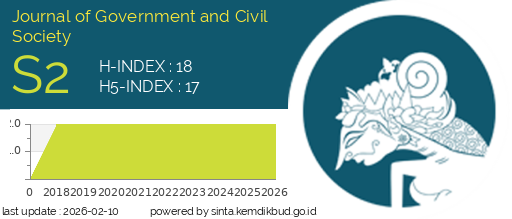
Scopus Citedness


The Journal of Governance and Empowerment Practice (JGEP) is an international, peer-reviewed academic publication dedicated to advancing empirical research, theoretical innovations, and critical policy evaluations at the intersection of public governance, social sustainability, and community empowerment.
JGEP is officially published under the auspices of the Association of Government Science of Muhammadiyah Higher Education Institutions (AIPPTM) in strategic partnership with academic networks to foster global discourse on participatory development and accountable public administration.
The journal actively invites comparative policy inquiries, action-research studies, and cross-national investigations that bridge state governance frameworks with grassroots community initiatives. JGEP serves as a premier international platform connecting scholars, policymakers, and social advocates committed to fostering inclusive, sustainable, and democratic governance structures.
Editorial determinations at JGEP are governed strictly by scholarly merit, methodological validity, original contributions, and independent peer evaluations-entirely uninfluenced by institutional affiliations or commercial interests.
The Journal of Governance and Empowerment Practice (JGEP) strictly complies with international ethical mandates regarding authorship attribution. To qualify as an author of a manuscript submitted to JGEP, all listed contributors must satisfy the following four core criteria simultaneously:
Substantial contributions to the conception, design, acquisition, analysis, or interpretation of data concerning governance frameworks and community practices.
Drafting the manuscript or revising it critically for intellectual depth, ensuring academic rigor aligned with global indexing standards.
Final approval of the version destined for publication, ensuring all co-authors have reviewed the final text and consented to submission.
Agreement to be accountable for all aspects of the research, ensuring questions regarding accuracy or integrity are thoroughly investigated and resolved.
In alignment with COPE guidelines, JGEP strictly prohibits ghost authorship (omitting qualifying contributors) and guest/gift authorship (crediting individuals without meaningful scholarly participation). Contributors who do not fulfill all four criteria must instead be acknowledged in the manuscript's Acknowledgments section.
Authorship Alterations: Any addition, deletion, or rearrangement of author names post-submission requires formal written justification endorsed by all co-authors and final approval from the Editor-in-Chief.
Submissions declined due to out-of-scope topics, significant methodological flaws, or excessive similarity index.
Submitted manuscripts undergo rigorous administrative and technical assessments. Editors evaluate thematic alignment with JGEP's Focus & Scope, verify template compliance, and run similarity checks via Turnitin (ensuring a strict threshold below 20%).
Qualifying papers are assigned to at least two independent international experts. Operating under a strict double-blind protocol, author and reviewer identities remain fully masked to guarantee impartial, rigorous academic critique.
The Editorial Board issues one of four formal determinations: Accept, Revisions Required, Resubmit for Review (requiring Round 2 evaluation), or Decline. Authors resubmit refined files accompanied by a detailed response matrix.
Accepted manuscripts undergo professional copyediting, layout formatting, proofreading, and DOI allocation. Articles are published online on a biannual schedule in (Issue 1) and (Issue 2).
| Publishing Workflow Stage | Issue 1 (April Publication) | Issue 2 (October Publication) |
|---|---|---|
| 1. Manuscript Submission | Open Year-Round (Continuous Submissions)
Submissions are processed dynamically upon receipt
|
|
| 2. Double-Blind Peer Review | Rolling review cycle (typically 4 – 12 weeks post-desk screening) | |
| 3. Revision, Copyediting & Layout | Finalized by | Finalized by |
| 4. Official Online Publication | ||