Bawaslu's Strategies for Preventing and Addressing Electoral Violations in the 2024 Election in Sinjai Regency
DOI:
https://doi.org/10.31000/jgcs.v10i1.15969Keywords:
Bawaslu, Electoral Violations, Preventive Strategies, Enforcement, Electoral OversightAbstract
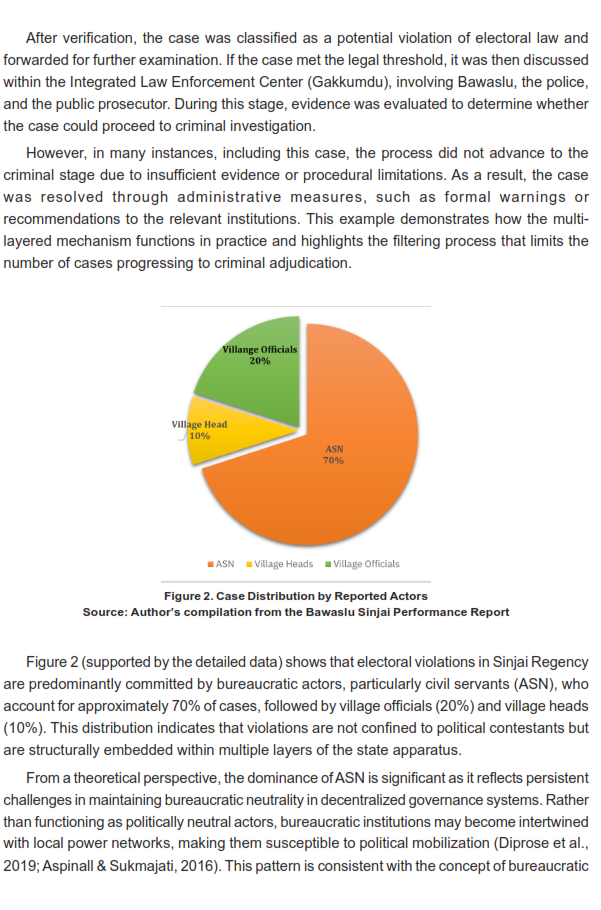
This study examines the strategies employed by the Election Supervisory Board (Bawaslu) in preventing and addressing electoral violations during the 2024 Election in Sinjai Regency, Indonesia. The research focuses on assessing the effectiveness of these strategies in relation to local institutional constraints and socio-political dynamics. A qualitative approach was applied through in-depth interviews with key stakeholders, field observations, and analysis of official documents. The findings indicate that electoral violations are predominantly committed by bureaucratic actors, particularly civil servants (ASN), accounting for approximately 70% of cases, mainly involving breaches of neutrality. Preventive strategies including voter education, participatory monitoring, and electoral socialization have contributed to increasing public awareness and expanding oversight networks. However, their effectiveness remains limited, as reflected in three key indicators: low public reporting participation, weak follow-up consistency on reported cases, and limited deterrent effects of sanctions. Furthermore, enforcement practices tend to be administrative rather than punitive, with only a small proportion of cases meeting criminal thresholds. This enforcement asymmetry reduces the overall deterrence capacity of the supervisory system.This study contributes to the literature on electoral governance by demonstrating that, in decentralized contexts, the effectiveness of electoral oversight is shaped not only by institutional design but also by bureaucratic behavior, local political structures, and enforcement capacity. Strengthening crosssector collaboration, improving technical capacity, and adopting data-driven oversight mechanisms are therefore essential to enhance electoral integrity at the local level.
Penelitian ini bertujuan untuk menganalisis strategi yang digunakan oleh Badan Pengawas Pemilihan Umum (Bawaslu) dalam mencegah dan menangani pelanggaran pemilu pada Pemilu Tahun 2024 di Kabupaten Sinjai, Indonesia. Fokus penelitian ini adalah menilai efektivitas strategi tersebut dalam konteks keterbatasan kelembagaan dan dinamika sosial-politik lokal. Pendekatan kualitatif digunakan melalui wawancara mendalam dengan informan kunci, observasi lapangan, serta analisis dokumen resmi. Hasil penelitian menunjukkan bahwa pelanggaran pemilu didominasi oleh aktor birokrasi, khususnya Aparatur Sipil Negara (ASN), yang mencakup sekitar 70% dari total kasus dan sebagian besar berkaitan dengan pelanggaran netralitas. Strategi pencegahan berupa pendidikan pemilih, pengawasan partisipatif, dan sosialisasi kepemiluan berkontribusi dalam meningkatkan kesadaran publik serta memperluas jejaring pengawasan. Namun demikian, efektivitasnya masih terbatas, yang tercermin dari rendahnya partisipasi pelaporan masyarakat, belum konsistennya tindak lanjut terhadap laporan pelanggaran, serta lemahnya efek jera dari sanksi yang diberikan. Selain itu, praktik penegakan hukum cenderung bersifat administratif dibandingkan represif, dengan hanya Sebagian kecil kasus yang memenuhi unsur tindak pidana. Ketimpangan dalam penegakan ini mengurangi daya cegah sistem pengawasan pemilu secara keseluruhan. Penelitian ini berkontribusi pada pengembangan kajian tata Kelola pemilu dengan menunjukkan bahwa dalam konteks desentralisasi, efektivitas pengawasan pemilu tidak hanya ditentukan oleh desain kelembagaan, tetapi juga oleh perilaku birokrasi, struktur politik lokal, serta kapasitas penegakan hukum. Oleh karena itu, penguatan kolaborasi lintas aktor, peningkatan kapasitas teknis, dan penerapan mekanisme pengawasan berbasis data menjadi langkah strategis untuk meningkatkan integritas pemilu di tingkat lokal.
References
Anindiati, A. (2024). Bawaslu Sinjai Handles 10 Cases of Alleged Local Election Violations. Rri.Co.Id. https://www.rri.co.id/pilkada-2024/1126067/bawaslu-sinjai-tangani-10-kasus-dugaan-pelanggaran-pilkada
Aspinall, E., Fossati, D., Muhtadi, B., & Warburton, E. (2020). Elites, Masses, and Democratic Decline in Indonesia. Democratization, 27(4), 505–526. https://doi.org/10.1080/13510347.2019.1680971 DOI: https://doi.org/10.1080/13510347.2019.1680971
Aspinall, E., & Mietzner, M. (2019). Indonesia’s Democratic Paradox: Competitive Elections amidst Rising Illiberalism. Bulletin of Indonesian Economic Studies. https://doi.org/10.1080/00074918.2019.1690412 DOI: https://doi.org/10.1080/00074918.2019.1690412
Aspinall, E., & Sukmajati, M. (2016). Electoral Dynamics in Indonesia: Money Politics, Patronage and Clientelism at the Grassroots. NUS Press. JSTOR. https://doi.org/https://doi.org/10.2307/j.ctv1xxzz2 DOI: https://doi.org/10.1355/cs38-2j
Bawaslu Sinjai. (2025). Bawaslu Sinjai Regency Holds an Institutional Evaluation Meeting to Review Subdistrict Election Supervisors’ Performance During the Local Election. Sinjai.Bawaslu.Go.Id. https://sinjai.bawaslu.go.id/berita/evaluasi-kinerja-panwaslu-kecamatan-selama-pilkada-bawaslu-kabupaten-sinjai-laksanakan-rapat?utm_source=chatgpt.com
Birch, S. (2023). The electoral benefits of environmental position-taking: Floods and electoral outcomes in England 2010–2019. European Journal of Political Research. https://doi.org/10.1111/1475-6765.12522 DOI: https://doi.org/10.1111/1475-6765.12522
Birch, S., & Muchlinski, D. (2018). Electoral violence prevention: what works? Democratization. https://doi.org/10.1080/13510347.2017.1365841 DOI: https://doi.org/10.1080/13510347.2017.1365841
Chalfin, A., & McCrary, J. (2017). Criminal deterrence: A review of the literature. In Journal of Economic Literature. https://doi.org/10.1257/jel.20141147 DOI: https://doi.org/10.1257/jel.20141147
Cresswell, J. W. (2017). Research Design (Qualitative, Quantitative, and Mixed Methods Approaches). In Sage Publication (Vol. 2017, Issue 150). https://doi.org/10.1002/tl.20234 DOI: https://doi.org/10.1002/tl.20234
d’Udekem, B. (2021). Agency Conflicts and Dividend Persistence. Journal of Financial Services Research. https://doi.org/10.1007/s10693-021-00348-x DOI: https://doi.org/10.1007/s10693-021-00348-x
Darmawan, I. M. D. H. (2024). The High Cost of Politics in Indonesia: An Exploration of Multi-perspectives from Academics, Students, Executive Officials, and Legislative Candidates. Besturkunde: Journal of Governmental Studies, 4(2), 115–127. https://doi.org/https://doi.org/10.53013/bestuurskunde.4.2.115-127 DOI: https://doi.org/10.53013/bestuurskunde.4.2.115-127
Diprose, R., McRae, D., & Hadiz, V. R. (2019). Two Decades of Reformasi in Indonesia: Its Illiberal Turn. Journal of Contemporary Asia, 49(5), 691–712. https://doi.org/10.1080/00472336.2019.1637922 DOI: https://doi.org/10.1080/00472336.2019.1637922
Grindle, M. S. (2012). Jobs for the Boys: Patronage and the State in Comparative Perspective. Harvard University Press. DOI: https://doi.org/10.4159/harvard.9780674065185
Intani, A. (2023). Analysis of the Closed Proportional Implementation Plan in the 2024 Election. Indonesian Journal of Advanced Research. https://doi.org/10.55927/ijar.v2i3.3454 DOI: https://doi.org/10.55927/ijar.v2i3.3454
Izhar, M. (2024). Not Impotent: Bawaslu Sinjai Handles 10 Election Violation Cases in the Regional Head Elections, Involving Village Heads to Regional Government Officials. Suarajelata.Com.
Lawrence Neuman. (2021). Research Methods in Communication Research. E-Journal of Media and Society (e-JOMS).
Mariana, D., & Husin, L. H. (2017). Democracy, local election, and political dynasty in Indonesian politics. Jurnal Wacana Politik. https://doi.org/10.24198/jwp.v2i2.13998 DOI: https://doi.org/10.24198/jwp.v2i2.13998
Mietzner, M. (2011). Book Review: Localising Power in Post-Authoritarian Indonesia: A Southeast Asia Perspective. South East Asia Research. https://doi.org/10.5367/sear.2011.0065 DOI: https://doi.org/10.5367/sear.2011.0065
Miles, M. B., Huberman, A. M., & Saldana, J. (2014). Qualitative Data Analysis: A Methods Sourcebook. SAGE Publications Inc. https://books.google.co.id/books?id=p0wXBAAAQBAJ&printsec=frontcover&hl=id#v=onepage&q&f=false
Mochtar, Z. A., & Afkar, K. (2022). President’s Power, Transition, and Good Governance. Bestuur. https://doi.org/10.20961/bestuur.v10i1.59098 DOI: https://doi.org/10.20961/bestuur.v10i1.59098
Nagin, D. S. (2013). Deterrence in the Twenty- First Century. Chicago Journals, 42(1), 199–263. https://doi.org/https://doi.org/10.1086/670398 DOI: https://doi.org/10.1086/670398
Nasution, S. R., Bernike, L., & Johan, M. (2022). Strategy of the Election Supervisory Body (Bawaslu) in Preventing Violations in the 2019 General Election (Election). JOELS: Journal of Election and Leadership. https://doi.org/10.31849/joels.v1i2.11161 DOI: https://doi.org/10.31849/joels.v1i2.11161
Norris, P. (2012). Why electoral integrity matters. In Why Electoral Integrity Matters. https://doi.org/10.1017/CBO9781107280861
Norris, P. (2014). Theories Why Electoral Integrity Matters. In Why Electoral Integrity Matters. https://doi.org/10.1017/cbo9781107280861.003 DOI: https://doi.org/10.1017/CBO9781107280861
Soderborg, S., & Muhtadi, B. (2021). Resentment and Polarization in Indonesia. SSRN Electronic Journal. https://doi.org/10.2139/ssrn.3873291 DOI: https://doi.org/10.2139/ssrn.3873291
Downloads
Published
Issue
Section
License
Copyright (c) 2026 Sumardi Sumardi, Jusniaty Jusniaty, Muhammad Lutfi, Achmad Nurmandi

This work is licensed under a Creative Commons Attribution-ShareAlike 4.0 International License.
Authors retain the full copyright of their published articles while granting the Journal of Government and Civil Society (JGCS) the right of first publication under the Creative Commons Attribution-ShareAlike 4.0 International License (CC BY-SA 4.0). Detailed licensing terms can be accessed at https://creativecommons.org/licenses/by-sa/4.0/.
Authors are permitted to redistribute their published work in other venues, such as institutional repositories, personal academic websites, or book chapters, provided that its original publication in JGCS is explicitly acknowledged.
Furthermore, authors are encouraged to disseminate their manuscripts through preprint servers or academic research networks prior to and during the submission process to enhance scholarly visibility and research impact.