
Strengthening Village-Based MSMEs Through Multi-Stakeholder Collaboration: Evidence from the Partnership Between Village Governments, MSMEs, and Banks
DOI:
https://doi.org/10.31000/cswb.v6i1.16998Keywords:
Multi-Stakeholder Collaboration, Village MSMEs, Digitalization, QRIS, Legal Formalization, Collaborative GovernanceAbstract
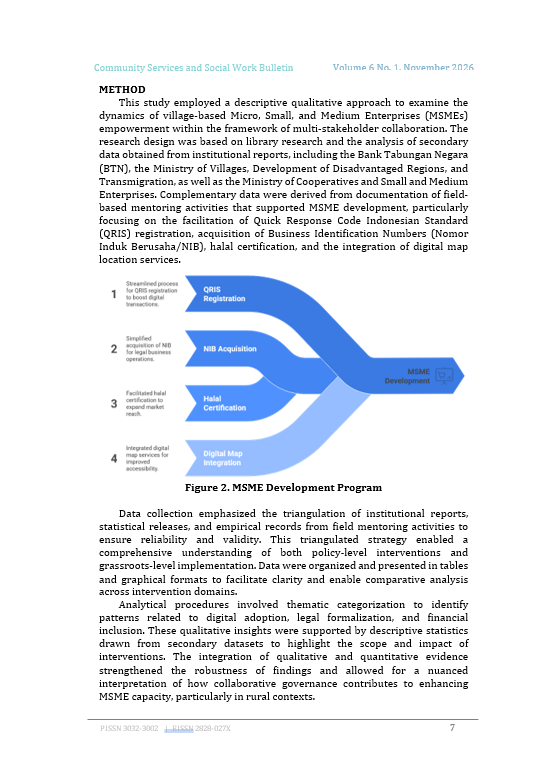
Micro, Small, and Medium Enterprises (MSMEs) contributed 61.07% to Indonesia's GDP in 2024 (~IDR 8,574 trillion) and absorbed 117 million workers (97%). However, only about 39.7% of MSMEs were connected to the digital ecosystem as of mid-2024. Digital adoption tools, such as the Quick Response Code Indonesian Standard (QRIS), and formalization programs (Business Identification Numbers/NIB and halal certification) were introduced via a multi-stakeholder governance model engaging village governments, MSMEs, and Bank BTN. This study evaluates the effectiveness of a multi-stakeholder collaboration model in accelerating digitalization, legal formalization, and financial inclusion among village-based MSMEs in Banten Province. A descriptive qualitative approach integrated with secondary dataset triangulation and field mentoring documentation was conducted. Multi-stakeholder collaboration led to a sixfold increase in MSME digital adoption (from 12.5% to 51.3%), enhanced legal compliance (30 MSMEs acquired NIB and halal certificates), increased average monthly turnover by 71.4%, and raised local employment by 54%. This community-centric governance model offers a scalable and replicable framework for rural economic empowerment and inclusive development.
References
Adityo Prodjo, W. (2023, November 14). Indeks Digitalisasi UMKM dari Bank BRI Dinilai jadi Tolak Ukur Pengembangan UMKM. KOMPAS.com. https://umkm.kompas.com/read/2023/11/14/173000083/indeks-digitalisasi-umkm-dari-bank-bri-dinilai-jadi-tolak-ukur-pengembangan
Ansell, C., & Gash, A. (2008). Collaborative Governance in Theory and Practice. Journal of Public Administration Research and Theory, 18(4), 543–571. https://doi.org/10.1093/jopart/mum032
Astuti, E. D., Tarto, T., Utami, R. T., & Oktaviany, V. (2025). TRANSFORMASI UMKM DIGITAL BERBASIS POTENSI LOKAL. JURNAL LENTERA BISNIS, 14(2), 2150–2158. https://doi.org/10.34127/jrlab.v14i2.1592
Bank Indonesia, B. I. (2023). Quick Response Code Indonesian Standard (QRIS). https://www.bi.go.id/en/fungsi-utama/sistem-pembayaran/ritel/kanal-layanan/qris/default.aspx
Bican, P. M., & Brem, A. (2020). Digital Business Model, Digital Transformation, Digital Entrepreneurship: Is There A Sustainable “Digital”? Sustainability, 12(13), 5239. https://doi.org/10.3390/su12135239
Fathoni, I., & Asfiah, N. (2024). Transformasi Digital Bisnis UMKM Di Indonesia Setelah Masa Pandemi. Innovative: Journal Of Social Science Research, 4(3), 10219–10236. https://doi.org/10.31004/innovative.v4i3.11354
Fauzi, M. N., Musarofah, S., Masadah, M., Pamudji, L., & Sudarmaji, T. (2025). Penguatan SDM Kreatif dalam Pemanfaatan Artificial Intelligence untuk Pemasaran UMKM Lamongan. AKM: Aksi Kepada Masyarakat, 6(1), 363–372. https://doi.org/10.36908/akm.v6i1.1534
Indonesia.go.id, Indonesia. go. id. (2023). Semakin Nyata Peran QRIS bagi Pemulihan Ekonomi. https://indonesia.go.id/kategori/editorial/7832/semakin-nyata-peran-qris-bagi-pemulihan-ekonomi?lang=1
Indriastuti, M., & Kartika, I. (2022). The Impact of Digitalization on MSMEs’ Financial Performance: The Mediating Role of Dynamic Capability. Jurnal Economia, 18(2), 240–255. https://doi.org/10.21831/economia.v18i2.42790
Junaidi, M. (2024, November 4). UMKM HEBAT, PEREKONOMIAN NASIONAL MENINGKAT. https://djpb.kemenkeu.go.id/kppn/curup/id/data-publikasi/artikel/2885-umkm-hebat,-perekonomian-nasional-meningkat.html
Megawati, L. R. (2020). Integrated Assistance Model in The Framework of Strengthening The Foundation of MSMEs. Business Review and Case Studies, 1(1), 24–24. https://doi.org/10.17358/brcs.1.1.24
Meidyasari, S. (2024). Analysis of the Impact of Digitalization on MSME Economic Growth in Indonesia. Advances In Social Humanities Research, 2(11), 1231–1238. https://doi.org/10.46799/adv.v2i11.305
Ndraha, A. B., Zebua, D., Zega, A., & Zebua, M. K. (2024). Dampak Ekonomi Digital Terhadap Pertumbuhan Umkm Di Era Industri 4.0. Jurnal Ilmu Ekonomi Dan Bisnis, 1(1), 27–32. https://doi.org/10.70134/jukoni.v1i1.23
Nugraheni, A. (2025, May 7). Optimalisasi Platform Digital Memperkuat Pasar UMKM. Kompas.id. https://www.kompas.id/artikel/optimalisasi-platform-digital-memperkuat-pasar-umkm
Purnomo, S., & Purwandari, S. (2025). A Comprehensive Micro, Small, and Medium Enterprise Empowerment Model for Developing Sustainable Tourism Villages in Rural Communities: A Perspective. Sustainability, 17(4), 1368. https://doi.org/10.3390/su17041368
Rahmawati, N. K., Muktiyanto, A., & Rahayu, H. C. (2025). Pengaruh Transformasi Digital Dalam Peningkatan Pendapatan UMKM Perempuan di Jabodetabek. Journal of Accounting and Finance Management, 6(1), 70–87. https://doi.org/10.38035/jafm.v6i1.1584
Rusliana, N., Surgawati, I., Kadarisman, E., & Putra, A. S. (2024). Identifikasi Dampak Kemitraan Pemerintah terhadap Kinerja Usaha UMKM di Jawa Barat. Jurnal Ekonomi-Qu, 14(2), 57–65. https://doi.org/10.35448/jequ.v14i2.30145
Saleh, C., Mohamad, S., Talipi, N., & Budiawan, S. (2025). Measuring the Impact of Digital Technology Adoption on the Operational Efficiency of MSMEs in Indonesia. Amsir Accounting & Finance Journal, 3(1), 27–34. https://doi.org/10.56341/aafj.v3i1.570
Supari, S., & Anton, H. (2022). The Impact of the National Economic Recovery Program and Digitalization on MSME Resilience during the COVID-19 Pandemic: A Case Study of Bank Rakyat Indonesia. Economies, 10(7), 160. https://doi.org/10.3390/economies10070160
Suprayogi, Y., Luckyardi, S., Kurnia, D., & Khairusy, M. A. (2024). Linguistic Technopreneurship in Business Success Digitalization for Small Medium Enterprises in West Java: Implication for Language Education. International Journal of Language Education, 8(2), 343–358.
Titin, Sutrisno, Mahmudah, H., Muhtarom, A., & Syamsuri. (2024). Effect of Business Digitalization and Social Media on MSME Performance with Digital Competence as a Mediating Variable. Scientific Journal of Informatics, 11(3), 645–660. https://doi.org/10.15294/sji.v11i3.9942
Wediawati, B., Adriani, Z., Setiawati, R., Ratnawati, R., & Dewi, E. (2025). The Impact of Entrepreneurial, Financial, and Digital Literacy on MSME Performance. Jurnal Ilmiah Manajemen Kesatuan, 13(4), 2643–2658. https://doi.org/10.37641/jimkes.v13i4.3411
Yahya, M. F. T., & Faiz, F. A. (2024). Peningkatan Standar Mutu UMKM Dengan Implementasi Digitalisasi di Indonesia. Journal of Economics and Policy Studies (JEPS), 5(2). https://doi.org/10.21274/jeps.v5i2.10555
Downloads
Published
Issue
Section
License

This work is licensed under a Creative Commons Attribution-ShareAlike 4.0 International License.
Community Services and Social Work Bulletin right of first publication with the work simultaneously licensed under Creative Commons Attribution-ShareAlike 4.0 International License(CC BY-SA 4.0) that allows others to share (copy and redistribute the material in any medium or format) and adapt (remix, transform, and build upon the material) the work for any purpose, even commercially with an acknowledgment of the work's authorship and initial publication in Community Services and Social Work Bulletin. Authors are able to enter into separate, additional contractual arrangements for the non-exclusive distribution of the journal's published version of the work (e.g., post it to an institutional repository or publish it in a book), with an acknowledgment of its initial publication in Community Services and Social Work Bulletin. Authors are permitted and encouraged to post their work online (e.g., in institutional repositories or on their website) prior to and during the submission process, as it can lead to productive exchanges, as well as earlier and greater citation of published work (See The Effect of Open Access).
