Accreditation & Indexing
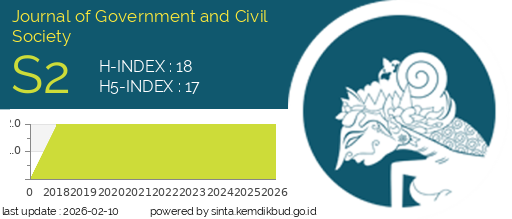

The Journal of Government and Civil Society (JGCS) is committed to upholding the highest standards of publication ethics and academic integrity. This statement is based on the principles of the Committee on Publication Ethics (COPE) Best Practice Guidelines and Elsevier Recommendations. All parties involved in the publishing process—authors, editors, and peer reviewers—are expected to agree to and adhere to these ethical standards.
In accordance with COPE and international publishing ethics, Generative AI and AI-assisted technologies (such as ChatGPT, Large Language Models, or automated writing tools) CANNOT be credited as authors or co-authors on any manuscript submitted to JGCS. Authorship implies legal responsibility and accountability for the accuracy, integrity, and originality of the research, which AI tools cannot accept.
Authors reporting results of original research should present an accurate account of the work performed as well as an objective discussion of its significance. Authors may be asked to provide raw research data in connection with a paper for editorial review, and should retain such data for a reasonable time after publication.
Authors must ensure that they have written entirely original works. If the authors have used the work or words of others, this must be appropriately cited or quoted. Plagiarism in all its forms constitutes unethical publishing behavior and is strictly unacceptable. All manuscripts submitted to JGCS are screened using Turnitin originality checks.
Authors should not submit manuscripts describing essentially the same research to more than one journal concurrently. Submitting the same manuscript to more than one journal constitutes unethical publishing behavior.
Authorship should be limited to those who have made a significant contribution to the conception, design, execution, or interpretation of the reported study. All significant contributors must be listed as co-authors. Proper acknowledgment of the work of others must always be given.
If the work involves human subjects or survey participants, authors must ensure informed consent was obtained and privacy rights observed. Authors must disclose any financial or substantive conflict of interest that might influence the results or interpretation of their manuscript.
The Editor-in-Chief and Editorial Board of JGCS are responsible for deciding which submitted articles should be published, based purely on academic merit, validity, and scope relevance. Editors evaluate manuscripts without regard to race, gender, sexual orientation, religious belief, ethnic origin, citizenship, or political philosophy of the authors.
Editors and editorial staff will not disclose any information about a submitted manuscript to anyone other than the corresponding author, reviewers, and publisher. Editors will recuse themselves from considering manuscripts in which they have competing conflicts of interest resulting from competitive, collaborative, or other connections with authors or institutions.
Editors will take reasonably responsive measures when ethical complaints or misconduct allegations have been presented regarding a submitted or published paper. If a complaint is upheld, appropriate notes, corrections, or retractions will be published in accordance with COPE procedures.
Peer review assists editors in making editorial decisions and helps authors improve their papers. Any selected referee who feels unqualified or knows that prompt review will be impossible should notify the editor and excuse themselves from the process.
Manuscripts received for review are confidential documents and must be treated as such. Reviews must be conducted objectively; personal criticism of authors is strictly inappropriate. Referees should express their views clearly with supporting arguments.
Privileged information or ideas obtained through peer review must be kept confidential and not used for personal advantage. Reviewers must not consider manuscripts in which they have conflicts of interest resulting from competitive, collaborative, or other connections with any of the authors or institutions connected to the paper.