From Data Visualization to Institutional Sequence: Dashboard Governance and Vertical Accountability in Indonesian Local Government
DOI:
https://doi.org/10.31000/jgcs.v10i2.16574Keywords:
Dashboard Governance, Vertical Accountability, Performance Management, Digital Government, Indonesian Local GovernmentAbstract
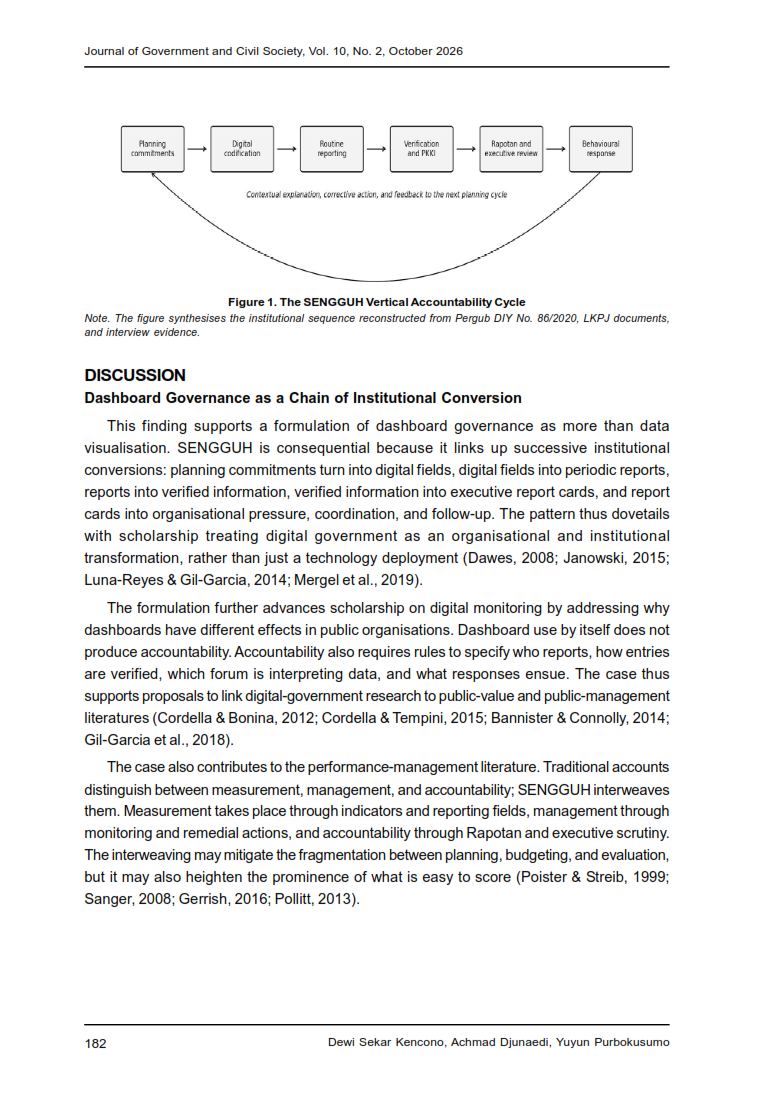
Digital dashboards are increasingly embedded in planning, monitoring, reporting, and executive oversight, yet their accountability effects depend on the institutional routines and authority structures in which they operate. This article examines SENGGUH (Sistem Evaluasi Pertanggungjawaban Pembangunan Daerah), the development-control and evaluation system of the Special Region of Yogyakarta (DIY), Indonesia, a special-status subnational setting in which executive authority has a distinctive legal and historical configuration. The qualitative single-case study triangulates 16 public regulatory, planning, smart-province, and accountability documents with 18 semi-structured interviews conducted from May 2025 to January 2026; seven interviews form the core analytic subset. The findings reconstruct an institutional sequence of planning codification, recurrent reporting, verification, executive escalation through Rapotan, and comparative visibility. The analysis also identifies boundary conditions: indicator-based monitoring can privilege readily measurable work, comparative exposure can create incentives for strategic attention to visible metrics, and the force of executive review is conditioned by the authority of the forum. The evidence does not establish performance manipulation or causal effects on service outcomes. Instead, it shows that vertical accountability emerges when digital information is embedded in verification, executive forums, and organisational consequences, while remaining constrained by attribution, interdependence, and selective visibility. The case therefore shifts attention from dashboard design alone to the institutional sequence and contextual authority that convert visibility into accountable action.
Dashboard digital semakin terintegrasi dalam perencanaan, pemantauan, pelaporan, dan pengawasan eksekutif, tetapi dampaknya terhadap akuntabilitas bergantung pada rutinitas kelembagaan dan struktur kewenangan tempat sistem tersebut beroperasi. Artikel ini mengkaji SENGGUH (Sistem Evaluasi Pertanggungjawaban Pembangunan Daerah), sistem pengendalian dan evaluasi pembangunan Daerah Istimewa Yogyakarta (DIY), Indonesia, sebuah konteks subnasional berstatus khusus dengan konfigurasi kewenangan eksekutif yang khas secara hukum dan historis. Studi kasus kualitatif ini mentriangulasi 16 dokumen regulasi, perencanaan, smart province, dan akuntabilitas dengan 18 wawancara semi-terstruktur yang dilakukan antara Mei 2025 dan Januari 2026; tujuh wawancara menjadi inti analisis. Temuan merekonstruksi rangkaian kelembagaan berupa kodifikasi perencanaan, pelaporan berulang, verifikasi, eskalasi eksekutif melalui Rapotan, dan visibilitas komparatif. Analisis juga menunjukkan kondisi pembatas: pemantauan berbasis indikator dapat lebih menonjolkan pekerjaan yang mudah diukur, paparan komparatif dapat menciptakan insentif untuk memusatkan perhatian pada metrik yang terlihat, dan kekuatan pengawasan eksekutif dipengaruhi oleh kewenangan forum. Bukti tidak menunjukkan manipulasi kinerja maupun dampak kausal terhadap hasil layanan. Akuntabilitas vertikal muncul ketika informasi digital tertanam dalam verifikasi, forum eksekutif, dan konsekuensi organisasi, tetapi tetap dibatasi oleh persoalan atribusi, saling ketergantungan, dan visibilitas selektif
References
Bannister, F., & Connolly, R. (2014). ICT, public values and transformative government: A framework and programme for research. Government Information Quarterly, 31(1), 119-128. https://doi.org/10.1016/j.giq.2013.06.002
Bannister, F., & Connolly, R. (2020). The future isn't what it used to be: Forecasting the impact of ICT on government. Government Information Quarterly, 37(1), 101410.
Behn, R. D. (2003). Why measure performance? Different purposes require different measures. Public Administration Review, 63(5), 586-606. https://doi.org/10.1111/1540-6210.00322
Bevan, G., & Hood, C. (2006). What's measured is what matters: Targets and gaming in the English public health care system. Public Administration, 84(3), 517-538. https://doi.org/10.1111/j.1467-9299.2006.00600.x
Bovens, M. (2007). Analysing and assessing accountability: A conceptual framework. European Law Journal, 13(4), 447-468. https://doi.org/10.1111/j.1468-0386.2007.00378.x
Brandsma, G. J., & Schillemans, T. (2013). The accountability cube: Measuring accountability. Journal of Public Administration Research and Theory, 23(4), 953-975. https://doi.org/10.1093/jopart/mus034
Bromley, P., & Powell, W. W. (2012). From smoke and mirrors to walking the talk: Decoupling in the contemporary world. Academy of Management Annals, 6(1), 483-530. https://doi.org/10.1080/19416520.2012.684462
Busuioc, E. M., & Lodge, M. (2016). The reputational basis of public accountability. Governance, 29(2), 247-263. https://doi.org/10.1111/gove.12161
Cordella, A., & Bonina, C. M. (2012). A public value perspective for ICT enabled public sector reforms: A theoretical reflection. Government Information Quarterly, 29(4), 512-520. https://doi.org/10.1016/j.giq.2012.03.004
Cordella, A., & Tempini, N. (2015). E-government and organizational change: Reappraising the role of ICT and bureaucracy in public service delivery. Government Information Quarterly, 32(3), 279-286. https://doi.org/10.1016/j.giq.2015.03.005
Courty, P., & Marschke, G. (2004). An empirical investigation of gaming responses to explicit performance incentives. Journal of Labor Economics, 22(1), 23-56. https://doi.org/10.1086/380404
Cucciniello, M., Porumbescu, G. A., & Grimmelikhuijsen, S. (2017). 25 years of transparency research: Evidence and future directions. Public Administration Review, 77(1), 32-44. https://doi.org/10.1111/puar.12685
Dawes, S. S. (2008). The evolution and continuing challenges of e-governance. Public Administration Review, 68(S1), S86-S102. https://doi.org/10.1111/j.1540-6210.2008.00981.x
de Bruijn, H. (2002). Performance measurement in the public sector: Strategies to cope with the risks of performance measurement. International Journal of Public Sector Management, 15(7), 578-594. https://doi.org/10.1108/09513550210448607
de Jong, E., & Twikromo, A. (2017). Friction within harmony: Everyday dynamics and the negotiation of diversity in Yogyakarta, Indonesia. Journal of Southeast Asian Studies, 48(1), 71-90. https://doi.org/10.1017/S0022463416000485
Dunleavy, P., Margetts, H., Bastow, S., & Tinkler, J. (2006). New public management is dead-long live digital-era governance. Journal of Public Administration Research and Theory, 16(3), 467-494. https://doi.org/10.1093/jopart/mui057
Gerrish, E. (2016). The impact of performance management on performance in public organizations: A meta-analysis. Public Administration Review, 76(1), 48-66. https://doi.org/10.1111/puar.12433
Gil-Garcia, J. R., Dawes, S. S., & Pardo, T. A. (2018). Digital government and public management research: Finding the crossroads. Public Management Review, 20(5), 633-646. https://doi.org/10.1080/14719037.2017.1327181
Government of the Special Region of Yogyakarta. (2018). Laporan Keterangan Pertanggungjawaban Gubernur Daerah Istimewa Yogyakarta Tahun 2018.
Government of the Special Region of Yogyakarta. (2019). Laporan Keterangan Pertanggungjawaban Gubernur Daerah Istimewa Yogyakarta Tahun 2019.
Government of the Special Region of Yogyakarta. (2020). Laporan Keterangan Pertanggungjawaban Gubernur Daerah Istimewa Yogyakarta Tahun 2020.
Government of the Special Region of Yogyakarta. (2022). Laporan Keterangan Pertanggungjawaban Gubernur Daerah Istimewa Yogyakarta Tahun 2022.
Government of the Special Region of Yogyakarta. (2023). Laporan Keterangan Pertanggungjawaban Gubernur Daerah Istimewa Yogyakarta Tahun 2023.
Government of the Special Region of Yogyakarta. (2024). Laporan Keterangan Pertanggungjawaban Gubernur Daerah Istimewa Yogyakarta Tahun 2024.
Government of the Special Region of Yogyakarta. (2025). Laporan Keterangan Pertanggungjawaban Gubernur Daerah Istimewa Yogyakarta Tahun 2025.
Government of the Special Region of Yogyakarta. (2025). Rencana Kerja Pemerintah Daerah Daerah Istimewa Yogyakarta Tahun 2026.
Governor of the Special Region of Yogyakarta. (2019). Peraturan Gubernur Daerah Istimewa Yogyakarta Nomor 46 Tahun 2019 tentang Rencana Aksi Daerah Jogja Smart Province Tahun 2019-2023.
Governor of the Special Region of Yogyakarta. (2020). Peraturan Gubernur Daerah Istimewa Yogyakarta Nomor 86 Tahun 2020 tentang Pengendalian dan Evaluasi Pembangunan Daerah.
Governor of the Special Region of Yogyakarta. (2024). Peraturan Gubernur Daerah Istimewa Yogyakarta Nomor 32 Tahun 2024 tentang Rencana Induk Jogja Smart Province Tahun 2024-2028.
Grimmelikhuijsen, S., Porumbescu, G., Hong, B., & Im, T. (2013). The effect of transparency on trust in government: A cross-national comparative experiment. Public Administration Review, 73(4), 575-586. https://doi.org/10.1111/puar.12047
Hood, C. (2006). Gaming in targetworld: The targets approach to managing British public services. Public Administration Review, 66(4), 515-521. https://doi.org/10.1111/j.1540-6210.2006.00612.x
Janowski, T. (2015). Digital government evolution: From transformation to contextualization. Government Information Quarterly, 32(3), 221-236. https://doi.org/10.1016/j.giq.2015.07.001
Janssen, M., & Estevez, E. (2013). Lean government and platform-based governance-Doing more with less. Government Information Quarterly, 30(S1), S1-S8. https://doi.org/10.1016/j.giq.2012.11.003
Klievink, B., Romijn, B.-J., Cunningham, S., & de Bruijn, H. (2017). Big data in the public sector: Uncertainties and readiness. Information Systems Frontiers, 19(2), 267-283. https://doi.org/10.1007/s10796-016-9686-2
Koppell, J. G. S. (2005). Pathologies of accountability: ICANN and the challenge of multiple accountabilities disorder. Public Administration Review, 65(1), 94-108. https://doi.org/10.1111/j.1540-6210.2005.00434.x
Kroll, A. (2015). Drivers of performance information use: Systematic literature review and directions for future research. Public Performance & Management Review, 38(3), 459-486. https://doi.org/10.1080/15309576.2015.1006469
Lindquist, E. A., & Huse, I. (2017). Accountability and monitoring government in the digital era: Promise, realism and research for digital-era governance. Canadian Public Administration, 60(4), 627-656. https://doi.org/10.1111/capa.12243
Luna-Reyes, L. F., & Gil-Garcia, J. R. (2014). Digital government transformation and internet portals: The co-evolution of technology, organizations, and institutions. Government Information Quarterly, 31(4), 545-555. https://doi.org/10.1016/j.giq.2014.08.001
Meijer, A. J. (2013). Understanding the complex dynamics of transparency. Public Administration Review, 73(3), 429-439. https://doi.org/10.1111/puar.12032
Mergel, I., Edelmann, N., & Haug, N. (2019). Defining digital transformation: Results from expert interviews. Government Information Quarterly, 36(4), 101385. https://doi.org/10.1016/j.giq.2019.06.002
Moynihan, D. P., Herd, P., & Harvey, H. (2015). Administrative burden: Learning, psychological, and compliance costs in citizen-state interactions. Journal of Public Administration Research and Theory, 25(1), 43-69. https://doi.org/10.1093/jopart/muu009
Moynihan, D. P., & Pandey, S. K. (2010). The big question for performance management: Why do managers use performance information? Journal of Public Administration Research and Theory, 20(4), 849-866. https://doi.org/10.1093/jopart/muq004
Pardo, T. A., Gil-Garcia, J. R., & Luna-Reyes, L. F. (2010). Collaborative governance and cross-boundary information sharing: Envisioning a networked and IT-enabled public administration. Government Information Quarterly, 27(3), 231-241. https://doi.org/10.1016/j.giq.2010.03.002
Poister, T. H., & Streib, G. (1999). Performance measurement in municipal government: Assessing the state of the practice. Public Administration Review, 59(4), 325-335. https://doi.org/10.2307/977569
Pollitt, C. (2006). Performance information for democracy: The missing link? Evaluation, 12(1), 38-55. https://doi.org/10.1177/1356389006064191
Pollitt, C. (2013). The logics of performance management. Evaluation, 19(4), 346-363. https://doi.org/10.1177/1356389013505040
Power, M. (1997). The audit society: Rituals of verification. Oxford University Press.
Republic of Indonesia. (2012). Undang-Undang Republik Indonesia Nomor 13 Tahun 2012 tentang Keistimewaan Daerah Istimewa Yogyakarta.
Romzek, B. S., & Dubnick, M. J. (1987). Accountability in the public sector: Lessons from the Challenger tragedy. Public Administration Review, 47(3), 227-238. https://doi.org/10.2307/975901
Sanger, M. B. (2008). From measurement to management: Breaking through the barriers to state and local performance. Public Administration Review, 68(S1), S70-S85. https://doi.org/10.1111/j.1540-6210.2008.00980.x
Smith, P. (1995). On the unintended consequences of publishing performance data in the public sector. International Journal of Public Administration, 18(2-3), 277-310. https://doi.org/10.1080/01900699508525011
van Thiel, S., & Leeuw, F. L. (2002). The performance paradox in the public sector. Public Performance & Management Review, 25(3), 267-281. https://doi.org/10.1080/15309576.2002.11643661
Downloads
Published
Issue
Section
License
Copyright (c) 2026 Dewi Sekar Kencono, Achmad Djunaedi, Yuyun Purbokusumo

This work is licensed under a Creative Commons Attribution-ShareAlike 4.0 International License.
Authors retain the full copyright of their published articles while granting the Journal of Government and Civil Society (JGCS) the right of first publication under the Creative Commons Attribution-ShareAlike 4.0 International License (CC BY-SA 4.0). Detailed licensing terms can be accessed at https://creativecommons.org/licenses/by-sa/4.0/.
Authors are permitted to redistribute their published work in other venues, such as institutional repositories, personal academic websites, or book chapters, provided that its original publication in JGCS is explicitly acknowledged.
Furthermore, authors are encouraged to disseminate their manuscripts through preprint servers or academic research networks prior to and during the submission process to enhance scholarly visibility and research impact.