Corruption Network in Bank BJB Advertising Procurement: An NVivo Content Analysis
DOI:
https://doi.org/10.31000/jgcs.v10i2.16754Keywords:
Corruption Network, Public Procurement, State Capture, Elite Actors, Public GovernanceAbstract
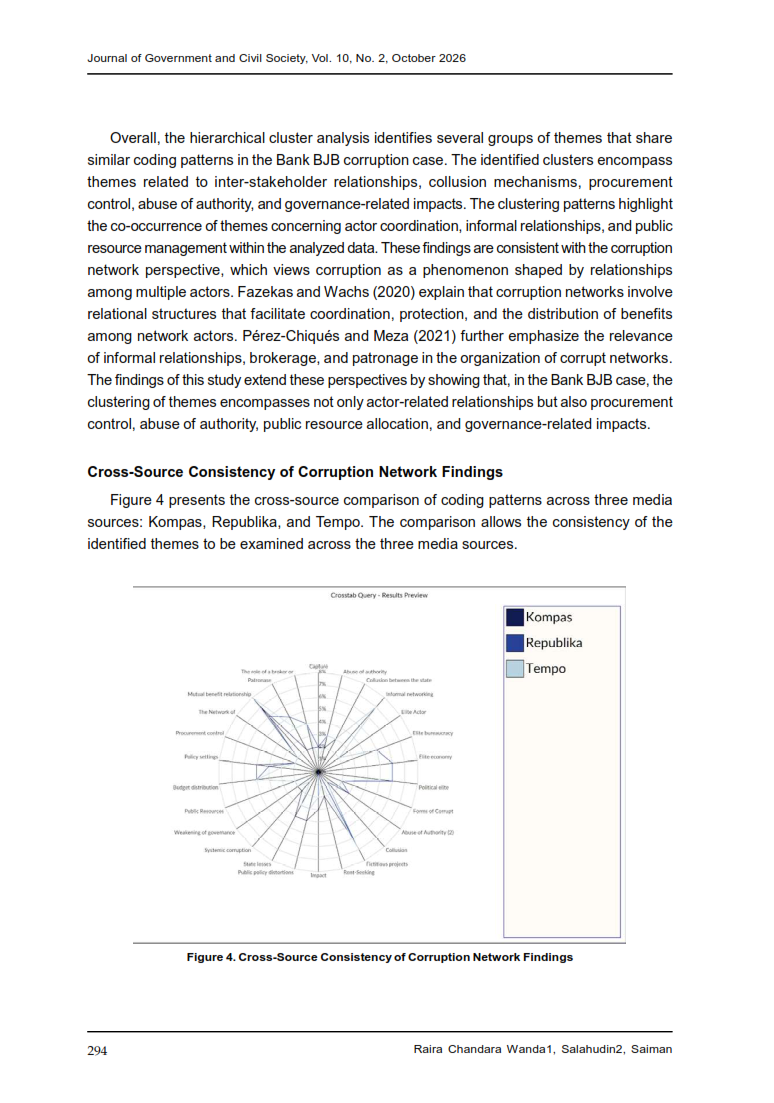
Corruption in public procurement remains a major governance challenge due to the complex interactions among political, bureaucratic, and economic actors. However, studies examining corruption as an organized network are still limited. This study analyzes the configuration and mechanisms of the alleged corruption network in the Bank BJB advertising procurement case using qualitative content analysis. Eight news reports from Kompas, Tempo, and Republika were analyzed using NVivo 14 through Hierarchy Chart, Project Map, Hierarchical Cluster Analysis, and Crosstab Query. The findings show that the corruption network was sustained by patronage, mutual benefit relationships, brokers, and informal networks, enabling procurement capture, public resource manipulation, fictitious projects, collusion, and abuse of authority. These practices not only caused state financial losses but also weakened governance through policy distortion, reduced oversight, and declining accountability. This study contributes to corruption network research by demonstrating how actor configurations and relational mechanisms sustain organized corruption and offers insights for strengthening transparency, accountability, and public procurement governance
Korupsi dalam pengadaan publik tetap menjadi tantangan tata kelola utama karena interaksi kompleks antara aktor politik, birokrasi, dan ekonomi. Namun, studi yang meneliti korupsi sebagai jaringan terorganisir masih terbatas. Studi ini menganalisis konfigurasi dan mekanisme jaringan korupsi yang diduga dalam kasus pengadaan iklan Bank BJB menggunakan analisis konten kualitatif. Delapan laporan berita dari Kompas, Tempo, dan Republika dianalisis menggunakan NVivo 14 melalui Hierarchy Chart, Project Map, Hierarchical Cluster Analysis, dan Crosstab Query. Temuan menunjukkan bahwa jaringan korupsi didukung oleh patronase, hubungan saling menguntungkan, broker, dan jaringan informal, memungkinkan penangkapan pengadaan, manipulasi sumber daya publik, proyek fiktif, kolusi, dan penyalahgunaan kekuasaan. Praktik-praktik ini tidak hanya menyebabkan kerugian keuangan negara tetapi juga melemahkan tata kelola melalui distorsi kebijakan, pengurangan pengawasan, dan penurunan akuntabilitas. Studi ini berkontribusi pada penelitian jaringan korupsi dengan menunjukkan bagaimana konfigurasi aktor dan mekanisme relasional mempertahankan korupsi terorganisir serta memberikan wawasan untuk memperkuat transparansi, akuntabilitas, dan tata kelola pengadaan publik.
References
Abigail, H. (2026). Political Dynasties and Local Corruption in Indonesia : Examining the Relationship between Concentrated Political Power and Public Accountability. 3(2), 131–148.
Abioro, T. A. (2021). Public procurement corruption and service delivery in Nigeria and South Africa. Public Procurement, Corruption and the Crisis of Governance in Africa, 249–267. https://doi.org/10.1007/978-3-030-63857-3_13
Bektas, E. (2025). Neopatrimonial Rule through Formal Institutions: The Case of Turkey. Government and Opposition, 60, 850–871. https://doi.org/10.1017/gov.2024.36
Diviák, T., & Lerner, J. (2025). Understanding the Mechanisms that Drive Relational Events Dynamics and Structure in Corruption Networks. Journal of Quantitative Criminology, 41(4), 523–547. https://doi.org/10.1007/s10940-025-09605-x
Diviák, T., & Lord, N. (2022). Tainted ties: the structure and dynamics of corruption networks extracted from deferred prosecution agreements. EPJ Data Science, 11(1). https://doi.org/10.1140/epjds/s13688-022-00320-2
Fahruh, N., Al, I., Amin, M. Al, Firmansyah, E., Sulthon, K., & Al, A. (2026). The Influence of Regional Political Intervention on Managerial Performance and Financial Governance of Regional-Owned Enterprises ( BUMD ). 01(02).
Fazekas, M., & Kocsis, G. (2020). Uncovering High-Level Corruption: Cross-National Objective Corruption Risk Indicators Using Public Procurement Data. British Journal of Political Science, 50(1), 155–164. https://doi.org/10.1017/S0007123417000461
Fazekas, M., & Wachs, J. (2020). Corruption and the network structure of public contracting markets across government change. Politics and Governance, 8(2), 153–166. https://doi.org/10.17645/pag.v8i2.2707
Fazeli, S., Sabetti, J., & Ferrari, M. (2023). Performing Qualitative Content Analysis of Video Data in Social Sciences and Medicine: The Visual-Verbal Video Analysis Method. International Journal of Qualitative Methods, 22. https://doi.org/10.1177/16094069231185452
Jancsics, D. (2024). Organization and organizationality of corruption. Sociology Compass, 18(7). https://doi.org/10.1111/soc4.13254
Jancsics, D., & Costa, J. (2024). Organizational forms of corruption networks: the Odebrecht-Toledo case. International Public Management Journal, 27(4), 559–582. https://doi.org/10.1080/10967494.2023.2260368
Jiang, J., & Zhang, M. (2020). Friends with benefits: Patronage networks and distributive politics in China. Journal of Public Economics, 184. https://doi.org/10.1016/j.jpubeco.2020.104143
Jiménez, A., Hanoteau, J., & Barkemeyer, R. (2022). E-procurement and firm corruption to secure public contracts: The moderating role of governance institutions and supranational support. Journal of Business Research, 149, 640–650. https://doi.org/10.1016/j.jbusres.2022.05.070
Komisi Pemberantasan Korupsi. (2025). KPK Tetapkan 5 Tersangka Korupsi Pengadaan Iklan di Bank BJB. Komisi Pemberantasan Korupsi. https://kpk.go.id/id/ruang-informasi/berita/kpk-tetapkan-5-tersangka-korupsi-pengadaan-iklan-di-bank-bjb
Kurniawan, R. (2025). Patronage Networks and Power Disparities: The Legacy of Political Patronage in Indonesia’s Governance and Democracy. Jurnal Politik Profetik, 13(1), 1–32. https://doi.org/10.24252/profetik.v13i1a1
Lindberg, S. I., Lo Bue, M. C., & Sen, K. (2022). Clientelism, corruption and the rule of law. World Development, 158. https://doi.org/10.1016/j.worlddev.2022.105989
Luna-Pla, I., & Nicolás-Carlock, J. R. (2020). Corruption and complexity: a scientific framework for the analysis of corruption networks. Applied Network Science, 5(1). https://doi.org/10.1007/s41109-020-00258-2
Lyra, M. S., Damásio, B., Pinheiro, F. L., & Bacao, F. (2022). Fraud, corruption, and collusion in public procurement activities, a systematic literature review on data-driven methods. Applied Network Science, 7(1), 83. https://doi.org/10.1007/s41109-022-00523-6
Morgan, H. (2022). Conducting a Qualitative Document Analysis. Qualitative Report, 27(1), 64–77. https://doi.org/10.46743/2160-3715/2022.5044
Mustafa, M. (2017). Democratic Decentralisation and Good Governance: The Political Economy of Procurement Reform in Decentralised Indonesia. December.
Olasolo, H., Palermo, P. G., & Blaise MacLean, R. J. (2025). The Case for Considering Corruption as a Central Element of Governance: Institutional and Organizational Corruption and Complex Corruption Networks. International Criminal Law Review, 25(2–3), 217–246. https://doi.org/10.1163/15718123-bja10230
Pérez-Chiqués, E., & Meza, O. (2021). Trust-based corruption networks: A comparative analysis of two municipal governments. Governance, 34(4), 1039–1056. https://doi.org/10.1111/gove.12554
Pujileksono, S., & Siregar, M. (2022). Pemahaman Korupsi Dalam Teori Pilihan Rasional dan Hubungan Prinsipal-Agen. Jurnal Ilmu Sosial Dan Ilmu Politik, 2(2), 139–151. https://doi.org/10.30742/juispol.v2i2.2592
Qomaruddin, Q., & Sa’diyah, H. (2024). Kajian Teoritis tentang Teknik Analisis Data dalam Penelitian Kualitatif: Perspektif Spradley, Miles dan Huberman. Journal of Management, Accounting, and Administration, 1(2), 77–84. https://doi.org/10.52620/jomaa.v1i2.93
Silitonga, M. S., Wittek, R., Snijders, T. A. B., & Heyse, L. (2023). Democratizing corruption: a role structure analysis of Indonesia’s “Big Bang” decentralization. Applied Network Science, 8(1). https://doi.org/10.1007/s41109-023-00535-w
Suardi, I., Rossieta, H., Djakman, C., & Diyanty, V. (2024). Procurement governance in reducing corruption in the indonesian public sector: a mixed method approach. Cogent Business and Management, 11(1). https://doi.org/10.1080/23311975.2024.2393744
Tzagkarakis, S. I., & Kritas, D. (2023). Mixed research methods in political science and governance: approaches and applications. Quality and Quantity, 57, 39–53. https://doi.org/10.1007/s11135-022-01384-y
Umanto, U., Wijaya, C., & Atmoko, A. W. (2015). Corporate Governance with the Institutional Theory Approach on Regional Development Banks in Indonesia. 22(2).
Wang, Y. (2020). A Network-Exchange Approach to Corruption: Brokers and Institution Spanning in A Chinese Corruption Network. Deviant Behavior, 41(12), 1636–1649. https://doi.org/10.1080/01639625.2019.1640525
Waxenecker, H., & Prell, C. (2024). Corruption dynamics in public procurement: A longitudinal network analysis of local construction contracts in Guatemala. Social Networks, 79, 154–167. https://doi.org/10.1016/j.socnet.2024.07.001
Yu, K. H., Kang, S. D., & Rhodes, C. (2020). The Partial Organization of Networked Corruption. Business and Society, 59(7), 1377–1409. https://doi.org/10.1177/0007650318775024
Downloads
Published
Issue
Section
License
Copyright (c) 2026 Raira Chandara Wanda, Salahudin Salahudin, Saiman Saiman

This work is licensed under a Creative Commons Attribution-ShareAlike 4.0 International License.
Authors retain the full copyright of their published articles while granting the Journal of Government and Civil Society (JGCS) the right of first publication under the Creative Commons Attribution-ShareAlike 4.0 International License (CC BY-SA 4.0). Detailed licensing terms can be accessed at https://creativecommons.org/licenses/by-sa/4.0/.
Authors are permitted to redistribute their published work in other venues, such as institutional repositories, personal academic websites, or book chapters, provided that its original publication in JGCS is explicitly acknowledged.
Furthermore, authors are encouraged to disseminate their manuscripts through preprint servers or academic research networks prior to and during the submission process to enhance scholarly visibility and research impact.