Institutional Rightsizing under Fiscal Constraints: Evidence from Regional Government Reform in Indonesia
DOI:
https://doi.org/10.31000/jgcs.v10i2.16849Keywords:
Institutional Rightsizing, Fiscal Constraint, Institutional Assessment, Organizational RestructuringAbstract
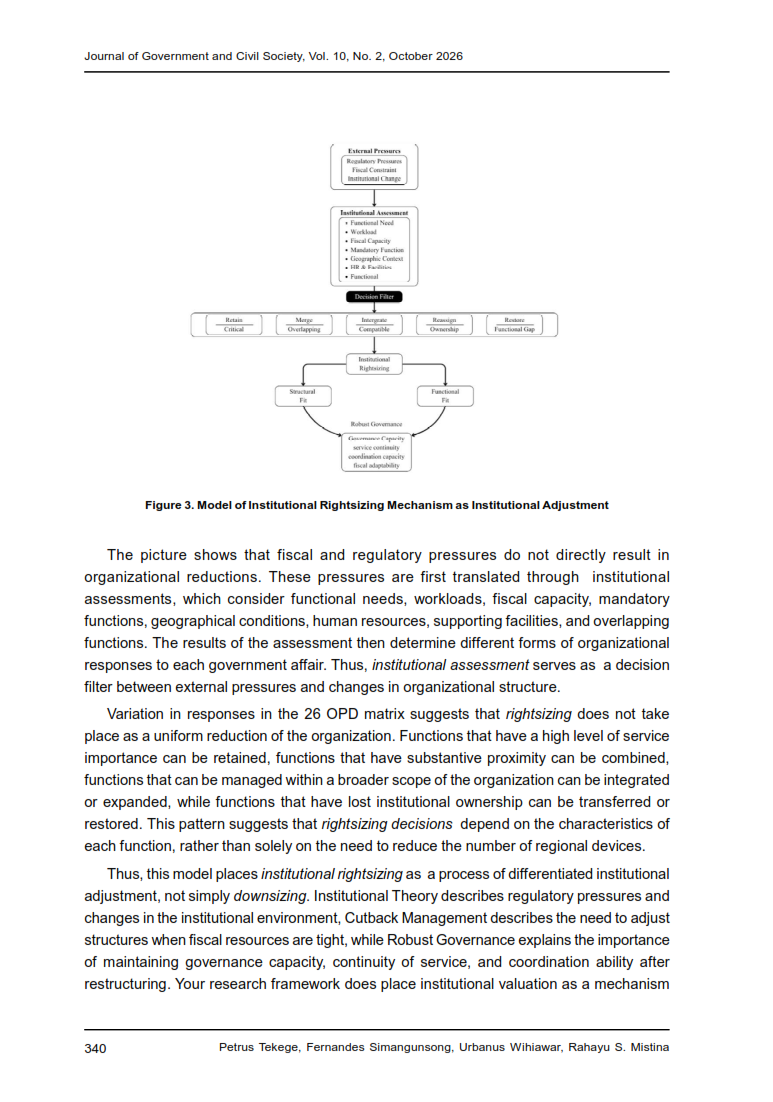
Fiscal constraints and institutional changes create a dilemma for local governments: organizational structures must be adjusted to available resources without undermining essential government functions and service capacity. This study aims to analyze how fiscal and regulatory pressures are translated into organizational restructuring in Nabire Regency and to formulate an institutional rightsizing configuration that remains aligned with workload, fiscal capacity, geographic characteristics, government needs, and institutional provisions. The study employs an embedded qualitative institutional case study combined with regulatory-based organizational assessment and policy design analysis. Data were obtained through semi-structured interviews with six purposively selected informants and analysis of regulatory, fiscal, organizational, and workload-assessment documents. The analysis combines institutional contextual analysis, weighted organizational assessment, geographic difficulty factors, and comparison of assessment results with the existing organizational structure. The findings show that institutional rightsizing does not operate as a linear downsizing process. Institutional and fiscal pressures trigger reassessment, while organizational decisions are differentiated according to the characteristics of each government function. The assessment produces five organizational responses: retain, merge, integrate/expand, reassign, and restore. The third restructuring alternative reduces the number of regional agencies from 23 to 17 through functional integration while maintaining government affairs and implementation capacity. The study concludes that institutional assessment functions as a meso-level mechanism linking external pressures to organizational design, while robust governance provides the basis for maintaining governance capacity, coordination, and service continuity. Thus, rightsizing represents selective institutional adjustment rather than uniform organizational reduction.
Tekanan fiskal dan perubahan kelembagaan menghadapkan pemerintah daerah pada kebutuhan menyesuaikan struktur organisasi dengan sumber daya yang tersedia tanpa mengurangi fungsi pemerintahan dan kapasitas pelayanan yang esensial. Penelitian ini bertujuan menganalisis bagaimana tekanan fiskal dan regulatif diterjemahkan ke dalam restrukturisasi organisasi di Kabupaten Nabire serta merumuskan konfigurasi institutional rightsizing yang selaras dengan beban kerja, kapasitas fiskal, karakteristik geografis, kebutuhan pemerintahan, dan ketentuan kelembagaan. Penelitian menggunakan embedded qualitative institutional case study yang dikombinasikan dengan regulatory-based organizational assessment dan policy design analysis. Data diperoleh melalui wawancara semi-terstruktur terhadap enam informan yang dipilih secara purposif serta analisis dokumen regulasi, fiskal, kelembagaan, dan penilaian beban kerja. Analisis dilakukan melalui institutional contextual analysis, penilaian organisasi berbobot dengan faktor kesulitan geografis, serta perbandingan hasil penilaian dengan struktur organisasi eksisting. Hasil penelitian menunjukkan bahwa institutional rightsizing tidak berlangsung sebagai proses downsizing yang linear. Tekanan fiskal dan regulatif memicu penilaian ulang, sedangkan keputusan organisasi dibedakan berdasarkan karakteristik setiap fungsi pemerintahan. Penilaian menghasilkan lima bentuk respons, yaitu retain, merge, integrate/expand, reassign, dan restore. Alternatif ketiga mengurangi jumlah perangkat daerah dari 23 menjadi 17 melalui integrasi fungsi tanpa menghilangkan urusan pemerintahan dan kapasitas pelaksanaannya. Penelitian menyimpulkan bahwa institutional assessment berfungsi sebagai mekanisme meso-level yang menghubungkan tekanan eksternal dengan desain organisasi, sedangkan robust governance menjadi orientasi untuk mempertahankan kapasitas pemerintahan, koordinasi, dan kesinambungan pelayanan. Dengan demikian, rightsizing merupakan penyesuaian kelembagaan yang selektif, bukan pengurangan organisasi secara seragam.
References
Aalbers, M. B., & Bernt, M. (2019). The political economy of managing decline and rightsizing. Urban Geography, 40(2), 165–173. https://doi.org/10.1080/02723638.2018.1524654
Ambe, C. M. (2025). Local Government Amalgamation and Financial Viability in Emerging Economies: A Systematic Literature Review. Journal of Public Administration, 60(2), 609–623. https://doi.org/10.53973/jopa.2025.60.2.a9
Ansell, C., Sørensen, E., & Torfing, J. (2023). Public administration and politics meet turbulence: The search for robust governance responses. Public Administration, 101(1), 3–22. https://doi.org/10.1111/padm.12874
Antaranews.com. (2026a). Pemkab Nabire adaptasi kebijakan pembangunan pasca efisiensi anggaran. Papuatengah.Antaranews.Com.
Antaranews.com. (2026b). Pemkab Nabire kelola fiskal secara hati-hati di tengah beban kewajiban. Papuatengah.Antaranews.Com.
Arkorful, V. E., Lugu, B. K., Hammond, A., & Basiru, I. (2021). Decentralization and citizens’ participation in local governance: Does trust and transparency matter?--An empirical study. Forum for Development Studies, 48(2), 199–223. https://doi.org/10.1080/08039410.2021.1872698
Ashworth, R., Boyne, G., & Delbridge, R. (2009). Escape from the Iron Cage? Organizational Change and Isomorphic Pressures in the Public Sector. Journal of Public Administration Research and Theory, 19(1), 165–187. https://doi.org/10.1093/jopart/mum038
Askim, J., Gendźwiłł, A., & Klausen, J. E. (2025). Problem indicators and territorial restructuring: do institutional decision rules matter? Journal of Public Policy, 45(1), 45–67. https://doi.org/10.1017/S0143814X25000054
Berthod, O. (2023). Institutional Theory of Organizations. In Global Encyclopedia of Public Administration, Public Policy, and Governance (pp. 6789–6793). Springer International Publishing. https://doi.org/10.1007/978-3-030-66252-3_63
BPS Kab Nabire. (2025). Profil Kemiskinan Kabupaten Nabire Maret 2025. Nabirekab.Bps.Go.Id.
Brien, S. T., Eger III, R. J., & Matkin, D. S. T. (2021). The Timing of Managerial Responses to Fiscal Stress. Public Administration Review, 81(3), 414–427. https://doi.org/10.1111/puar.13359
Budiman, H., Nurohmah, A., Pratiwi, C. N., & Islami, T. N. (2025). Implikasi Instruksi Presiden Nomor 1 Tahun 2025 terhadap efektivitas dan kinerja pemerintahan daerah. Justicia Journal, 14(2), 187–197. https://doi.org/10.32492/jj.v14i2.14201
Canavire-Bacarreza, G., Martinez-Vazquez, J., & Yedgenov, B. (2020). Identifying and disentangling the impact of fiscal decentralization on economic growth. World Development, 127, 104742. https://doi.org/10.1016/j.worlddev.2019.104742
Dick-Sagoe, C. (2020). Decentralization for improving the provision of public services in developing countries: A critical review. Cogent Economics & Finance, 8(1), 1804036. https://doi.org/10.1080/23322039.2020.1804036
DiMaggio, P. J., & Powell, W. W. (1983). The Iron Cage Revisited: Institutional Isomorphism and Collective Rationality in Organizational Fields. American Sociological Review, 48(2), 147–160. https://doi.org/10.2307/2095101
Haptari, V. D., Ginting, A. M., Aritonang, F. D., & Sofilda, E. (2024). Factors Influencing Regional Governments to Enhance Regional Financial Independence: Cases in Indonesian Provinces. OIDA International Journal of Sustainable Development, 17(09), 41–54.
Helmi, H. (2021). Penataan Peraturan Daerah dengan Metode Omnibus Law: Urgensi dan Mekanisme. Undang: Jurnal Hukum, 4(2), 441–472. https://doi.org/10.22437/ujh.4.2.441-472
Levine, C. H. (1978). Organizational Decline and Cutback Management. Public Administration Review, 38(4), 316–325. https://doi.org/10.2307/975813
Marselina, A., & Herianti, E. (2022). Determinan Kemandirian Keuangan Daerah. Jurnal Akuntansi Dan Governance, 2(2), 110–118. https://doi.org/10.24853/jago.2.2.110-118
Peretz, H. V. (2021). A perspective on organizational decline in the public sector: A case study. Public Money & Management, 41(2), 161–171. https://doi.org/10.1080/09540962.2019.1665360
Pramudana, I., & Perdana, S. (2023). Analisis Kewenangan Pelaksana Tugas Kepala Daerah Menurut Undang-Undang Nomor 23 Tahun 2014. EduYustisia, 2(1), 17–30.
Prasetyo, W. E. (2026). Faktor-Faktor Yang Memengaruhi Penyesuaian Analisis Standar Belanja (ASB) Pada Pemerintah Daerah. Accounting Global Journal, 10(1), 66–96.
Rizkiyah, P., Kirana, D., & Tjandra, R. (2026). Determinasi Keberhasilan Digital Government pada Pemerintah Daerah: Tinjauan Sistematis atas Faktor Organisasi dan Tata Kelola. Jurnal Akuntansi Keuangan Dan Perpajakan, 2(3), 481–487. http://jurnal.globalscients.com/index.php/jakp/article/view/1175
Rumesten, I., Helmanida, H., & Ngadino, A. (2020). Pengaturan Pembagian Urusan Pemerintahan; Kritik Terhadap Undang-Undang Nomor 23 Tahun 2014 Tentang Pemerintahan Daerah. Simbur Cahaya, 27(1), 134–155. https://doi.org/10.28946/sc.v27i1.808
Sima, M., Liang, P., & Qingjie, Z. (2023). The impact of fiscal decentralization on economic growth: A comparative analysis of selected African and OECD countries. Heliyon, 9(9).
Suardita, I. K. (2024). Konsistensi Pembentukan Peraturan Daerah Berdasarkan Hierarki Perundang-Undangan dalam Perspektif Hukum Kepegawaian. Jurnal Yustitia, 18(1), 64–80. https://doi.org/10.62279/yustitia.v18i1.1196
Syafri, R. A., Sofilda, E., & Suparyati, A. (2024). Determinan kemandirian keuangan pemerintah kabupaten/kota di Indonesia. Indonesian Treasury Review: Jurnal Perbendaharaan, Keuangan Negara Dan Kebijakan Publik, 9(4), 277–290. https://doi.org/10.33105/itrev.v9i4.858
Walker, K. D., & Kutsyuruba, B. (2020). Upgrading downsizing: Ethics and personnel reductions in declining organizations. European Journal of Educational Management, 3(2), 51–65. https://doi.org/10.12973/eujem.3.2.51
Warner, M. E., Aldag, A. M., & Kim, Y. (2021). Pragmatic Municipalism: U.S. Local Government Responses to Fiscal Stress. Public Administration Review, 81(3), 389–398. https://doi.org/10.1111/puar.13196
Zulaika, N., Lestari, D., & Istiqomah, H. (2025). Tantangan implementasi dan akuntabilitas anggaran program makanan bergizi gratis (MBG) berdasarkan Instruksi Presiden Nomor 1 Tahun 2025. Jurnal Penelitian Ilmiah Multidisipliner, 1(03), 426–435.
Downloads
Published
Issue
Section
License
Copyright (c) 2026 Petrus Tekege, Fernandes Simangunsong, Urbanus Wihiawar, Rahayu S Mistina

This work is licensed under a Creative Commons Attribution-ShareAlike 4.0 International License.
Authors retain the full copyright of their published articles while granting the Journal of Government and Civil Society (JGCS) the right of first publication under the Creative Commons Attribution-ShareAlike 4.0 International License (CC BY-SA 4.0). Detailed licensing terms can be accessed at https://creativecommons.org/licenses/by-sa/4.0/.
Authors are permitted to redistribute their published work in other venues, such as institutional repositories, personal academic websites, or book chapters, provided that its original publication in JGCS is explicitly acknowledged.
Furthermore, authors are encouraged to disseminate their manuscripts through preprint servers or academic research networks prior to and during the submission process to enhance scholarly visibility and research impact.