From Digital Vote Recapitulation to Democratic Legitimacy: Electoral Governance Innovation in Serang Regency, Indonesia
DOI:
https://doi.org/10.31000/jgcs.v10i2.17083Keywords:
digital electoral governance;, Sirekap;, electoral governance innovation;, democratic legitimacy;, throughput legitimacy;Abstract
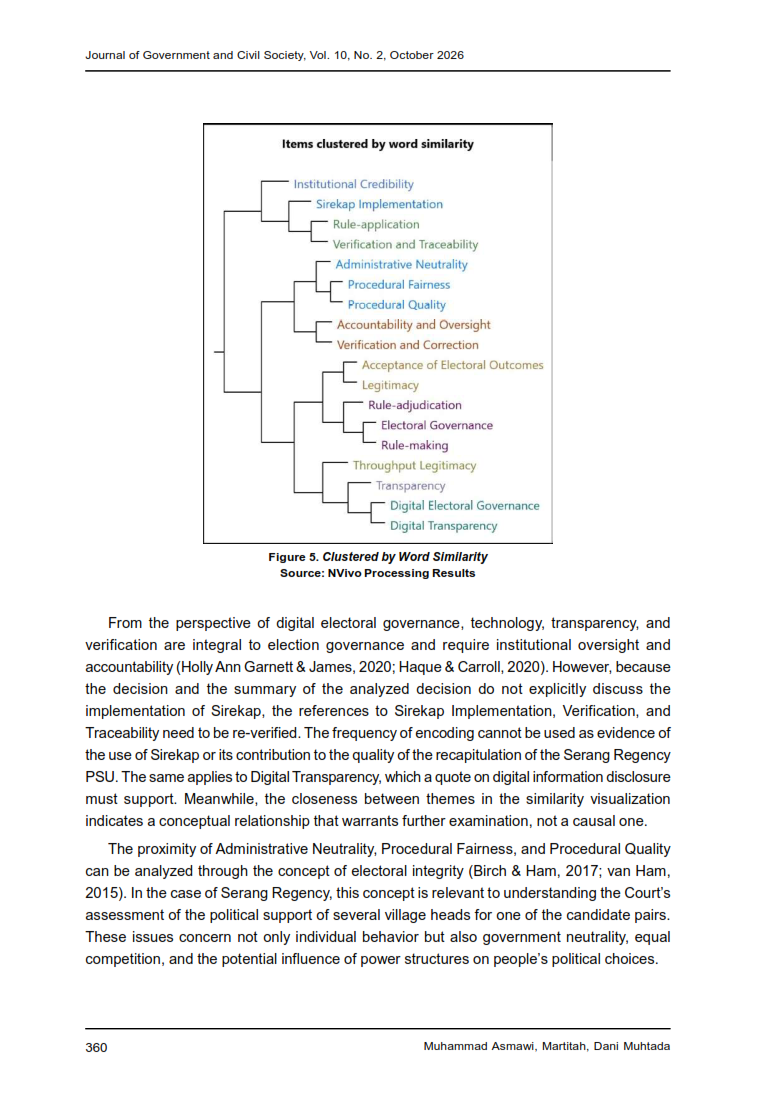
Digitalization of electoral administration offers opportunities to improve the transparency and traceability of election results, but its effectiveness remains dependent on process integrity and institutional capacity. This study aims to analyze the role of the Recapitulation Information System (Sirekap) in administering the results of the 2025 re-voting in the Serang Regency local election and its relationship with procedural quality and democratic legitimacy. The study employs a qualitative approach using an explanatory case study design. Data were collected through an analysis of the Constitutional Court's decision and its summary, official documents from the General Elections Commission (KPU) and the Election Supervisory Agency (Bawaslu), and relevant news reports. Data analysis was conducted in NVivo using thematic coding, Crosstab Query, and thematic similarity visualizations across four main categories: Electoral Governance, Digital Electoral Governance, Procedural Quality, and Legitimacy. The findings indicate that Electoral Governance and Procedural Quality are relatively dominant coding categories. The KPU is more prominently associated with rule application, whereas the Constitutional Court is more strongly associated with rule adjudication, procedural fairness, and administrative neutrality. Sirekap was used to support the documentation, transmission, and publication of re-voting results. However, technology does not automatically guarantee data accuracy or enhance public trust. This study concludes that digitalization contributes to democratic legitimacy indirectly through procedural quality, verification, oversight, and institutional accountability.
Digitalisasi administrasi pemilu menghadirkan peluang untuk meningkatkan transparansi dan keterlacakan hasil pemilihan, tetapi efektivitasnya tetap bergantung pada integritas proses dan kapasitas kelembagaan. Penelitian ini bertujuan untuk menganalisis peran Sistem Informasi Rekapitulasi (Sirekap) dalam administrasi hasil Pemungutan Suara Ulang (PSU) Pilkada Kabupaten Serang tahun 2025 serta keterkaitannya dengan kualitas prosedural dan legitimasi demokratis. Penelitian ini menggunakan pendekatan kualitatif dengan desain studi kasus eksplanatori. Data diperoleh melalui analisis dokumen putusan Mahkamah Konstitusi, ikhtisar putusan, dokumentasi resmi KPU dan Bawaslu, serta pemberitaan yang relevan. Analisis dilakukan menggunakan NVivo melalui thematic coding, Crosstab Query, serta visualisasi kemiripan tema berdasarkan empat kategori utama, yaitu Electoral Governance, Digital Electoral Governance, Procedural Quality, dan Legitimacy. Hasil penelitian menunjukkan bahwa Electoral Governance dan Procedural Quality merupakan kategori yang relatif dominan. KPU lebih menonjol dalam penerapan aturan (rule-application), sedangkan Mahkamah Konstitusi menonjol dalam penyelesaian sengketa (rule-adjudication), keadilan prosedural, dan netralitas administratif. Sirekap digunakan untuk mendukung dokumentasi, transmisi, dan publikasi hasil PSU. Namun, teknologi tidak secara otomatis menjamin akurasi data maupun meningkatkan kepercayaan publik. Penelitian ini menyimpulkan bahwa kontribusi digitalisasi terhadap legitimasi demokratis berlangsung secara tidak langsung melalui kualitas prosedural, verifikasi, pengawasan, dan akuntabilitas kelembagaan.
References
Antaranews.com. (2025a). KPU Serang mulai rekapitulasi suara hasil PSU di tingkat kabupaten. Antaranews.Com. https://banten.antaranews.com/berita/331809/kpu-serang-mulai-rekapitulasi-suara-hasil-psu-di-tingkat-kabupaten
Antaranews.com. (2025b). KPU umumkan hasil PSU Kabupaten Serang pada 24 April 2025. Antaranews.Com. https://www.antaranews.com/berita/4782465/kpu-umumkan-hasil-psu-kabupaten-serang-pada-24-april-2025
Birch, S., & Ham, C. Van. (2017). Getting away with foul play? The importance of formal and informal oversight institutions for electoral integrity. European Journal of Political Research, 56(3), 487–511. https://doi.org/https://doi.org/10.1111/1475-6765.12189
Caby, V., & Frehen, L. (2021a). How to Produce and Measure Throughput Legitimacy ? Lessons from a Systematic Literature Review. Politics and Governance, 9(1), 226–236. https://doi.org/10.17645/pag.v9i1.4011
Caby, V., & Frehen, L. (2021b). How to Produce and Measure Throughput Legitimacy? Lessons from a Systematic Literature Review. Politics and Governance, 9(1), 226–236. https://doi.org/https://doi.org/10.17645/pag.v9i1.4011
Dad, N., & Khan, S. (2023). Reconstructing elections in a digital world. South African Journal of International Affairs, 30(3), 473–496. https://doi.org/10.1080/10220461.2023.2265886
Garnett, Holly Ann, & James, Toby S. (2020). Cyber Elections in the Digital Age: Threats and Opportunities of Technology for Electoral Integrity. Election Law Journal: Rules, Politics, and Policy, 19(2), 111–126. https://doi.org/10.1089/elj.2020.0633
Garnett, H. A. (2019). Evaluating electoral management body capacity. International Political Science Review, 40(3), 335–353. https://doi.org/10.1177/0192512119832924
González, R., Mackenna, B., Scherman, A., & Joignant, A. (2024). Fairness beyond the ballot: A comparative analysis of failures of electoral integrity, perceptions of electoral fairness, and attitudes towards democracy across 18 countries. Electoral Studies, 87, 102740. https://doi.org/https://doi.org/10.1016/j.electstud.2023.102740
Haggart, B., & Keller, C. I. (2021). Democratic legitimacy in global platform governance. Telecommunications Policy, 45(6), 102152. https://doi.org/https://doi.org/10.1016/j.telpol.2021.102152
Haque, Ziaul, & Carroll, David. (2020). Assessing the Impact of Information and Communication Technologies on Electoral Integrity. Election Law Journal: Rules, Politics, and Policy, 19(2), 127–148. https://doi.org/10.1089/elj.2019.0558
Hibar, U., Wahyudi, W., Asnawi, A., & Saepudin, E. A. (2025). Juridical review of the decision of the constitutional court number 70/phpu. bup-xxiii/2025 re-voting of the serang regency election. LEGAL BRIEF, 14(1), 110–117. https://doi.org/10.35335/legal.v14i1.1264
Hidayat, A. N., Karlina, N., Pancasilawan, R., & Sumadinata, R. W. S. (2026). How electoral management bodies govern digital electoral systems: capacity, authority, and accountability. Frontiers in Political Science, Volume 8-2026. https://doi.org/10.3389/fpos.2026.1877569
Iusmen, I., & Boswell, J. (2017). The dilemmas of pursuing ‘throughput legitimacy’ through participatory mechanisms. West European Politics, 40(2), 459–478. https://doi.org/10.1080/01402382.2016.1206380
James, T. S., Garnett, H. A., Loeber, L., & van Ham, C. (2019). Electoral management and the organisational determinants of electoral integrity: Introduction. International Political Science Review, 40(3), 295–312. https://doi.org/10.1177/0192512119828206
Kerr, N., King, B. A., & Wahman, M. (2024). The Global Crisis of Trust in Elections. Public Opinion Quarterly, 88(SI), 451–471. https://doi.org/10.1093/poq/nfae016
Klaver, Joseph. (2025). Electoral Court and By-Elections in France: Guarantor of Electoral Integrity or Political Sideshow? Election Law Journal: Rules, Politics, and Policy, 24(2), 150–171. https://doi.org/10.1089/elj.2024.0011
Kpu.go.id. (2025). Rilis KPU Perkembangan Pasca Pelaksanaan PSU 9 Daerah. Kpu.Go.Id. https://www.kpu.go.id/berita/baca/12872/rilis-kpu-perkembangan-pasca-pelaksanaan-psu-9-daerah
Lehoucq, F. E. (2002). Can Parties Police Themselves? Electoral Governance and Democratization. International Political Science Review, 23(1), 29–46. https://doi.org/10.1177/0192512102023001002
Maulana, E., Kusnandar, M. I., & Firdaus, F. (2025). Dynamics of Considerations in the Constitutional Court’s Decision in Deciding on the Settlement of Disputes in the 2024 General Election of Regional Heads and Deputy Regional Heads of Serang Regency. Dharmawangsa: International Journal of the Social Sciences, Education and Humanitis, 6(3), 444–467. https://doi.org/10.46576/ijsseh.v6i3.7273
Mozaffar, S., & Schedler, A. (2002). The comparative study of electoral governance--Introduction. International Political Science Review, 23(1), 5–27. https://doi.org/10.1177/0192512102023001001
Nasuhaidi, Ahmad, Z. H., Rahmadhani, S., & Asiah, U. (2025). Efektivitas Kebijakan Penggunaan SIREKAP Untuk Transparansi Rekapitulasi Pada Rapat Pleno Kabupaten Tebo Pemilu 2024. Seminar Nasional LPPM Universitas Jambi October 7 2025, 139–146.
Norris, P. (2019). Conclusions: The new research agenda on electoral management. International Political Science Review, 40(3), 391–403. https://doi.org/10.1177/0192512119829869
Pal, M. (2021). Constitutional Design of Electoral Governance in Federal States. Asian Journal of Comparative Law, 16(S1), S23--S39. https://doi.org/10.1017/asjcl.2021.28
Paskarina, C., Ummah Mustofa, M., Hermawati, R., Nurmanto, E., & Wardana, R. (2025). Guarding the people’s vote: why ethics dimension matters for public trust to E-recapitulation in the Indonesia 2024 election. Cogent Social Sciences, 11(1), 2586372. https://doi.org/10.1080/23311886.2025.2586372
Rump, M. B. (2026). Comparative Perspectives on Electoral Integrity Beliefs : A Case Study of Austria and Germany. Politics and Governance, 14, 1–18.
Schedler, A. (2002). The Nested Game of Democratization by Elections. International Political Science Review, 23(1), 103–122. https://doi.org/10.1177/0192512102023001006
Schmidt, V., & Wood, M. (2019). Conceptualizing throughput legitimacy: Procedural mechanisms of accountability, transparency, inclusiveness and openness in EU governance. Public Administration, 97(4), 727–740. https://doi.org/https://doi.org/10.1111/padm.12615
Steffek, J. (2019). The limits of proceduralism: Critical remarks on the rise of ‘throughput legitimacy.’ Public Administration, 97(4), 784–796. https://doi.org/https://doi.org/10.1111/padm.12565
Tinanto, B., Zetra, A., & Putera, R. E. (2024). Diffusion of Recapitulation Information System (SIREKAP) Innovation in Realizing the Integrity of the 2024 Elections in Meranti Islands Regency, Riau Province, Indonesia. JPSI (Journal of Public Sector Innovations), 9(1), 24–33. https://journal.unesa.ac.id/index.php/jpsi/article/view/34391
van Ham, C. (2015). Getting elections right? Measuring electoral integrity. Democratization, 22(4), 714–737. https://doi.org/10.1080/13510347.2013.877447
Downloads
Published
Issue
Section
License
Copyright (c) 2026 Muhammad Asmawi, Martitah, Dani Muhtada

This work is licensed under a Creative Commons Attribution-ShareAlike 4.0 International License.
Authors retain the full copyright of their published articles while granting the Journal of Government and Civil Society (JGCS) the right of first publication under the Creative Commons Attribution-ShareAlike 4.0 International License (CC BY-SA 4.0). Detailed licensing terms can be accessed at https://creativecommons.org/licenses/by-sa/4.0/.
Authors are permitted to redistribute their published work in other venues, such as institutional repositories, personal academic websites, or book chapters, provided that its original publication in JGCS is explicitly acknowledged.
Furthermore, authors are encouraged to disseminate their manuscripts through preprint servers or academic research networks prior to and during the submission process to enhance scholarly visibility and research impact.