Accreditation & Indexing


This Issue has been available online since 30 April 2026 for the regular issue of Journal of Government and Civil Society. All Articles in this issue were authored/co-authored by 26 Authors from 4 countries (Indonesia, UAE, England, India)




p-ISSN: 2579-4396 • e-ISSN: 2579-440X
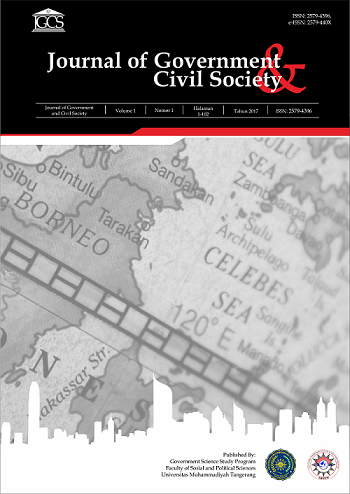
A peer-reviewed academic journal published biannually (April & October) by the Government Science Study Program at Universitas Muhammadiyah Tangerang in official collaboration with AIPPTM and KAPSIPI.
JGCS particularly welcomes empirical manuscripts, comparative studies, and subnational case studies offering globally relevant insights grounded in local governance, civic action, and public policy contexts.
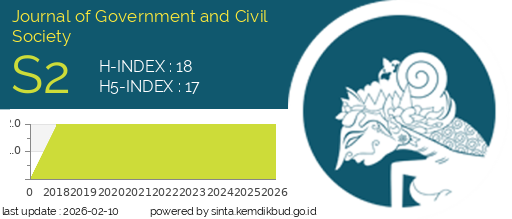
Accredited SINTA 2 by Kemdiktisaintek RI, strategically expanding its national and international scholarly footprint by upholding rigorous peer evaluation, double-blind review protocols, and open-access integrity.
Achieves broad international visibility through a global assembly of contributing authors across 4 continents, ensuring widespread indexing, citation impact, and internationally resonant policy discussions.
Investigates subnational administrative modernization, institutional adaptation, e-governance systems, and experimental public management models aimed at enhancing service delivery efficiency and local governance resilience.
Examines formal and informal democratic institutions, electoral dynamics, political behavior, and the role of civil society organizations, grassroots movements, and citizen networks in safeguarding civic space.
Analyzes public policy interventions, social protection schemes, and community-led adaptation strategies designed to mitigate socio-economic vulnerabilities, manage disasters, and improve human security.
Explores the intersection of state authority, market forces, resource distribution, and ecological sustainability, emphasizing institutional transparency, anti-corruption, and environmental stewardship.
To guarantee scientific rigor, all submissions undergo a structured two-stage review process. Initial Desk Screening evaluates scope alignment, structural template compliance, and similarity limits (Turnitin index < 20%). Qualifying manuscripts are subsequently assigned to expert peer reviewers under a strict Double-Blind Peer Review protocol.





Join an international network of contributing scholars across 4 continents. Prepare your manuscript adhering strictly to APA 7th Edition citation standards and our official article template.

